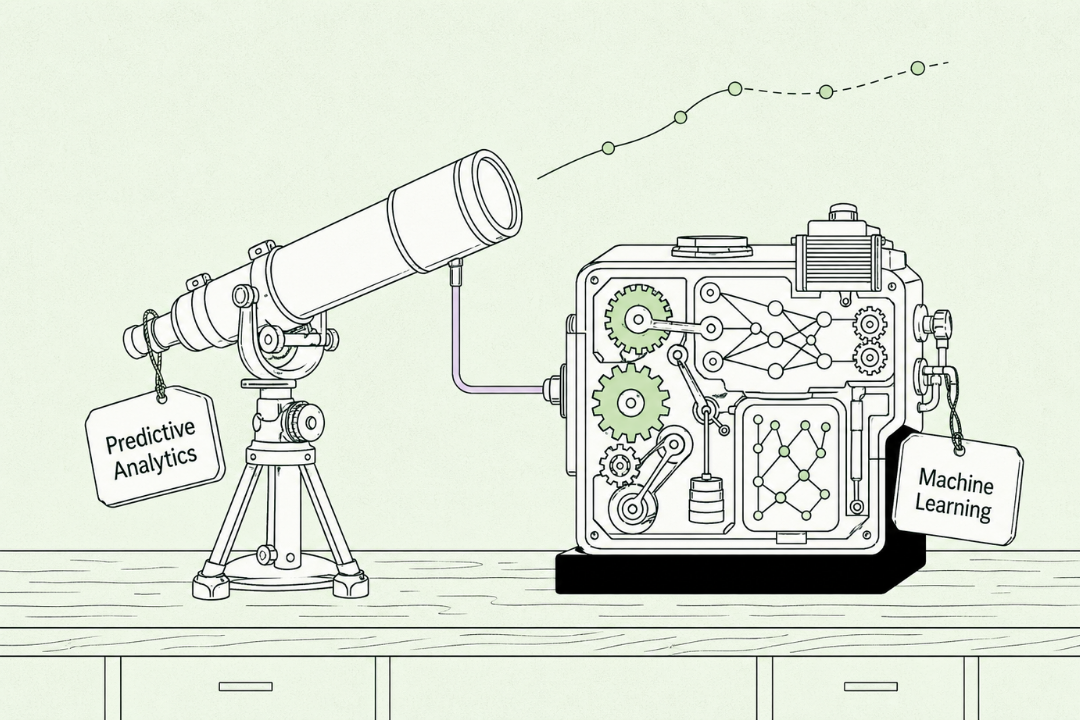
Machine learning and predictive analytics often get lumped together, but they’re not the same thing, so separating them will sharpen how you evaluate tools, build models, and explain strategy to stakeholders. Predictive analytics focuses on forecasting future outcomes, while machine learning offers methods that help build and improve those predictions.
Once you separate the business goal from the modeling method, it becomes much easier to choose the right tools, explain them internally, and apply them to real use cases. We’re here to help you solve this puzzle once and for all.
Key highlights:
- The main difference between predictive analysis and machine learning is that predictive analytics focuses on forecasting outcomes, while machine learning learns patterns from data to improve those forecasts.
- Predictive analytics with machine learning helps you predict churn, demand, and conversion probability, and assess fraud risk, with greater speed, scale, and accuracy.
- Pecan AI combines machine learning and predictive analytics into a single tool that builds predictive models and delivers them to production in about one week — about 32x faster than traditional AI and data science approaches.
What is predictive analytics?
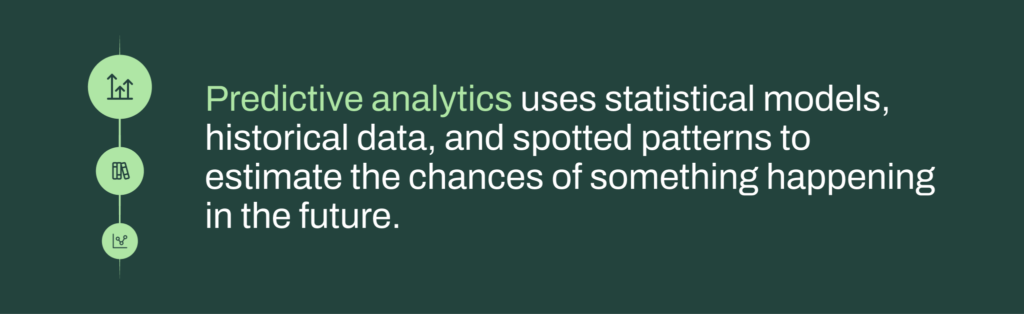
Predictive analytics is a branch of advanced analytics that uses your business’s past data to forecast what’s coming next. Want to know which customers might leave, which leads could turn into sales, which products might run out, or which shipments could be late? Predictive models help you answer those questions before they become problems.
Unravel the AI vs. predictive analytics mystery, too.
What is machine learning (ML)?
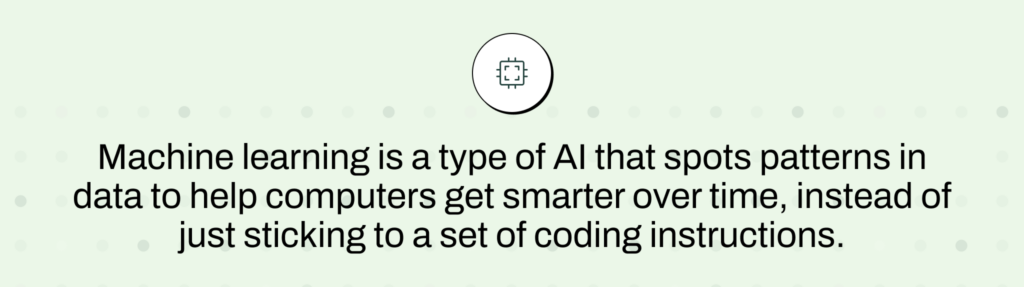
Machine learning is a type of artificial intelligence that trains computers to identify patterns in your data and improve the predictive accuracy of your models, without requiring a long list of rules. A model trained on ML algorithms learns from your history, figures out which signals matter, and then uses those trends and patterns to make new, smarter predictions.
What is the difference between predictive analytics and machine learning?
The difference between predictive analytics and machine learning is that predictive analytics is the broader business practice of forecasting future outcomes. Machine learning is one way to build the models that support those forecasts. Think of them this way: predictive analytics asks the question, and machine learning helps answer it.
See the main differentiators between predictive analytics and ML:
| Machine learning vs. predictive analytics differentiators | Predictive analytics | Machine learning |
| Primary focus | Forecasting future outcomes for business decisions | Learning patterns from data to improve model performance |
| Main question | What is likely to happen next? | Which patterns in the data best predict the outcome? |
| Business role | Forecasting goals and business application | Modeling method and training approach |
| Typical output |
|
|
| Best for | Teams that need forward-looking insights tied to business action | Teams that need flexible models for large, complex, or changing datasets |
Dive deeper into ML differences by exploring generative AI vs. predictive AI vs. machine learning.
How do predictive analytics and machine learning work together?
When predictive analytics and machine learning team up, you go from set-it-and-forget-it forecasts to predictions that actually keep up with your business. Machine learning algorithms improve the predictive process by learning from your historical data, applying those patterns to new data, and allowing you to retrain or rescore models as behavior changes, rather than rewriting prediction logic by hand each time.
This combination really shines when you’re juggling mountains of data, shifting trends, or decisions that need to happen yesterday.
Take a peek at the machine learning algorithms that deliver the most accurate predictions nowadays:
| ML algorithm type | Typical use case in predictive analytics | Algorithm strengths | Algorithm limitations |
| Regression | Forecasting churn risk, demand, LTV, or conversion likelihood when teams need a numeric prediction or probability |
| May miss nonlinear relationships and complex interactions |
| Decision trees | Segmenting customers or shipments into likely outcome paths |
| Can overfit and become unstable with small data changes |
| Random forest | Improving classification and regression performance for churn, fraud, or delivery risk prediction |
| Less interpretable than a single tree and can require more compute |
| Neural networks | Modeling complex behavioral patterns in large, high-dimensional datasets |
| Harder to explain and needs more data and tuning |
| Support vector machines | Classifying outcomes such as fraud risk or likely conversion in structured datasets |
| Harder to scale and less intuitive for business users |
| Clustering | Grouping customers, products, players, or accounts into similar segments before prediction |
| Doesn’t predict outcomes on its own and results depend on setup choices |
| Ensemble methods | Combining multiple machine learning models to improve performance for demand, churn, fraud, or retention prediction |
| Can reduce model transparency and increase complexity |
Discover if your business is AI ready.
Benefits of using machine learning for predictive analytics
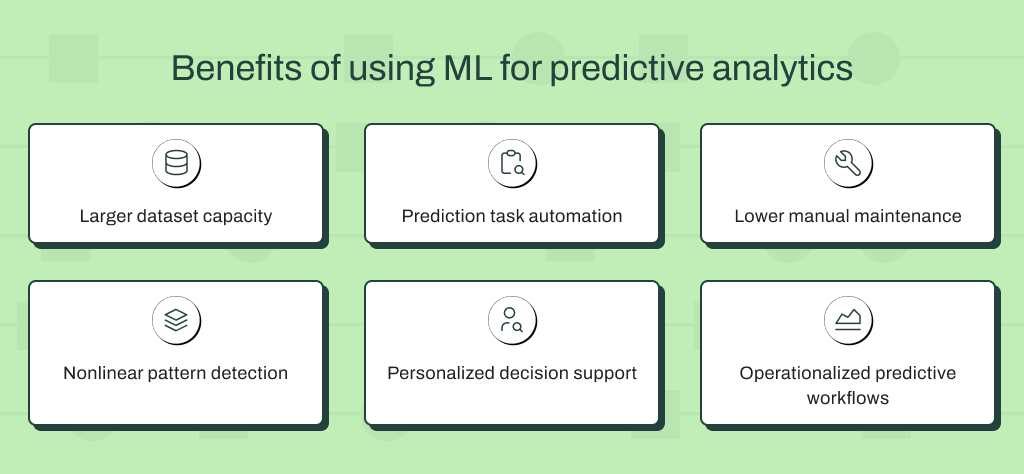
Using predictive analytics with machine learning can bring benefits across many industries. Take supply chains as an example: According to Gartner, top-performing supply chain organizations use AI and ML to optimize processes at more than twice the rate of low-performing peers.
Predictive analytics and ML optimize business processes for you by:
- Handling larger and more complex datasets without forcing analysts to simplify every variable manually.
- Automating repetitive prediction tasks, such as scoring customers, leads, shipments, or products on a recurring basis.
- Reducing manual intervention in model updates and maintenance as fresh data changes the underlying patterns.
- Capturing nonlinear relationships across many signals, which often improves performance over simpler rule-based methods.
- Supporting more personalized decisions in marketing, retention, supply chain, and customer operations.
- Turning predictive work into an operational workflow instead of a one-off analytics project.
Master machine learning for predictive analytics.
Challenges of machine learning in predictive analytics (and how to solve them)
Predictive analytics with machine learning can hit some speed bumps, especially when it comes to trusting your data. IBM found that 45% of 5,000 executives worry about data accuracy and bias, making these two challenges their top AI headaches.
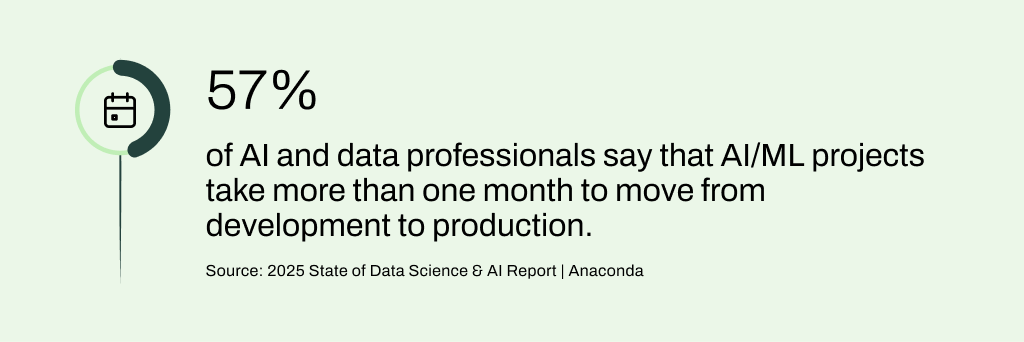
But it’s not just about the data. The 2025 Anaconda’s State of Data Science & AI Report shows that getting ML out of the lab and into action takes time: 57% of respondents say it takes more than a month to move AI from development to production.
Explore the main challenges that come with predictive analytics and ML and learn how to make these red flags turn into green lights:
| Machine learning in predictive analytics challenge | Why do you need to solve it | How to solve it |
| Incomplete or inconsistent data sources | Missing fields and conflicting data formats weaken model reliability and create biased predictions |
|
| Difficult integrations | Customer, marketing, product, and operations information often live in separate tools |
|
| Poor data labeling | Weak labels make supervised models less reliable and reduce training quality |
|
| Outdated or irrelevant data | Old data can reflect patterns that no longer match current behavior or market conditions |
|
| Lack of model transparency | Teams hesitate to act when predictions feel opaque or ungrounded |
|
| Key drivers identification in predictions | Teams need to know which inputs influence outcomes most so they can intervene if needed |
|
| Need for specialized data science teams | Many teams lack the internal resources to build, validate, and maintain models from scratch |
|
| Investment in infrastructure and tools | Building an internal ML stack can require significant budget and maintenance effort |
|
| Slow AI deployment | Long deployment cycles delay business value and make predictions less useful by the time you can act on them |
|
Learn how to master data preparation for machine learning.
Get the most out of predictive analytics and machine learning with Pecan AI
Just having fancy ML algorithms doesn’t make your predictions better. What really moves the needle is putting those algorithms to work on your actual business data, checking the results, and getting predictions into the tools you already use to make decisions.
Pecan handles the whole predictive analytics journey, so you can go from a business question to ready-to-use outcomes, without wrestling with every technical detail yourself.
Here’s how Pecan works and brings machine learning and predictive analytics to a whole new level:
- Ask a business question in plain English.
- Wait as our predictive AI agent handles data prep and feature engineering.
- Review the model created with Pecan’s ML algorithms and validate it.
- Get predictions right inside your business workflows, such as CRMs, data warehouses, and other tools.
- Keep a human in the loop just to monitor and ask the AI agent to retrain your model when business conditions change.
You bring the business question. Pecan turns machine learning into predictions your team can actually use. Want to see predictive analysis and machine learning in action? Book a demo and discover how we help you build models faster, act sooner, and get more value out of your data.

Ori is a Customer Engagement Manager at Pecan AI, where he’s helped customers adopt predictive analytics from first demo to real business impact. He’s grown through Pecan support and customer success, wearing hats across CSM, solutions engineering, and customer onboarding, and turning complex ML concepts into simple, actionable workflows.