Churn is the classic party crasher for B2B SaaS growth, especially if you only notice the warning signs once customers are halfway out the door. Most advice for this kind of problem stops at measuring cancellation rates, but what about spotting trouble early and actually doing something about it?
In this guide, we’ll walk you through our favorite churn-busting tips and show you how AI can help you keep more customers (and revenue) right where they belong. No more last-minute scramble when it’s too late: Let’s get ahead of SaaS churn analytics prediction and prevention together.
Key highlights:
- Tips on how to reduce churn in B2B SaaS include watching for early signals, monitoring cancellation metrics, scoring risk for each account, triggering retention plays, and retraining your predictive model.
- To predict customer churn, you need to define the churn outcome you want to predict, connect and prepare your SaaS data, review model accuracy, and push predictions to your workflows.
- Pecan AI helps you reduce churn in your B2B SaaS company by handling data prep, building smart predictive models, and flagging churn risks before they become a problem.
What is SaaS churn analysis?
SaaS churn analysis is the process of digging into customer behavior, account trends, and revenue shifts to figure out why folks cancel, downgrade, or skip renewal. To manage this investigation well, you can use churn prediction software to help you spot usage patterns, uncover the real reasons behind customer loss, and catch the early signals before risk starts to climb.
Why should SaaS teams care about churn risk?
SaaS teams should care about churn risks because cancellations cut recurring revenue, weaken net revenue retention (NRR), slow expansion, and stretch customer acquisition costs (CAC) payback.
A 2025 McKinsey analysis of 55 B2B tech SaaS companies found that top-quartile performers reached an NRR of 113%, while bottom-quartile peers reached 98%. That gap shows why churn risk deserves early attention: stronger retention supports growth from your existing customer base, while weaker retention forces your team to work harder just to replace lost revenue.
Explore the best churn analytics solutions.
How to predict churn with AI (No data science degree needed)
You don’t need a data science degree to predict churn. You just need to choose the right churn prediction software that leverages AI to connect product, billing, support, and CRM signals to analyze your customer data and predict cancellation patterns from it.
Take The Credit Pros as an example: by using Pecan AI, their team achieved a 25% reduction in cancellations within 30 days of intervention, built models 3 times faster than traditional approaches, and cut the churn prediction model creation time from about 3 months to 3 weeks. They also pushed predictions straight into Salesforce, so that CS could act inside their existing workflows.
Here’s the step-by-step tutorial on how to use a customer churn prediction software with AI, like Pecan:
1. Define the churn outcome you want to predict
The best tools for predictive analytics equipped with AI allow you to define your churn problem just by asking a business question in plain English. Go ahead and make questions such as “Which customers are likely to cancel their subscription in the next 30 days?”, or “Which clients are likely to reduce seats or cut spend in the next renewal cycle?”
AI can only help you with SaaS churn analysis if you frame that business question clearly, since your predictive model can only learn from the outcome you define.
Dive deeper into churn predictionin subscription services.
2. Connect customer, product, billing, and support data
Churn prediction works best when your model gets the full story. Product usage can reveal slipping customer engagement, billing data might flag payment hiccups, support tickets can hint at frustration, and CRM activity shows if renewal energy is running low.
Mix all those signals together, and AI paints a much clearer picture of cancellation risks, improving forecast accuracy and making churn predictions more reliable.
3. Count on AI to prepare your data and build the features automatically
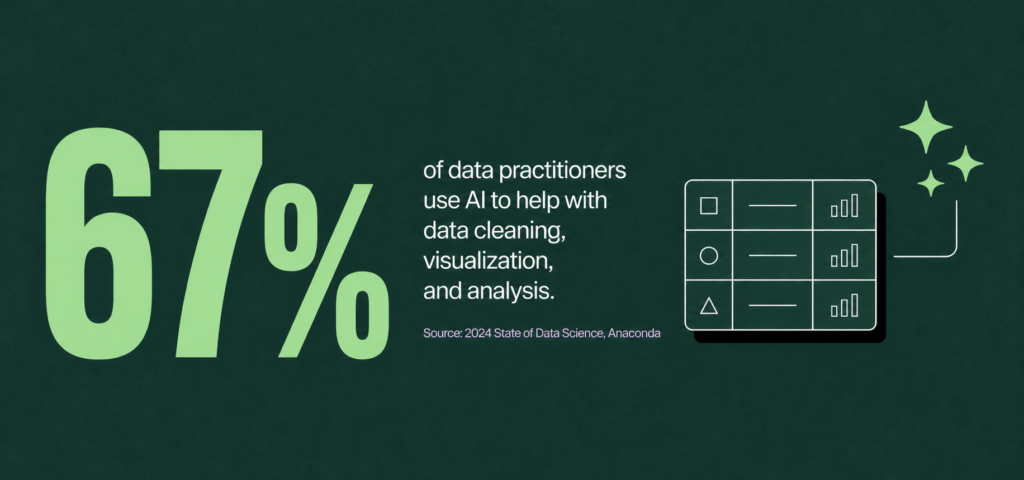
Data prep usually eats up most of the work in churn modeling. Anaconda’s State of Data Science report says data preparation and cleaning remain the two most time-consuming tasks for professionals, with 67% of them using AI to help with cleaning, visualization, and analysis.
One more reason to give AI churn prevention software a go: it saves you from spending weeks preparing datasets before the model even starts delivering value.
4. Review model accuracy and the main churn drivers
Once your churn model is up and running, check how it’s performing. Look at the risk scores, confidence levels, and top reasons for each prediction. This close analysis will help you know exactly why an account looks risky and what to do about it.
5. Push churn scores straight into the tools you already use
No churn score should sit on a dashboard for its own sake. A good churn prediction and prevention tool must deliver predictions to your CRM, customer success platform, or data warehouse.
When choosing a predictive churn modeling platform, make sure it plugs right into your current workflows. No extra hoops to jump through.
Explore more about how to create a predictive model.
What to look for in a SaaS churn analytics tool?
You need to trust your churn prediction model so you can act on its outcomes. Unfortunately, not all tools can handle trust, usability, and actionability. According to a McKinsey AI survey, companies cite inaccuracy (23%), cybersecurity (16%), and explainability (12%) as the top risks associated with adopting AItools.
Want to dodge those scary stats? Make sure your AI tool for predicting SaaS customer churn checks all these boxes:
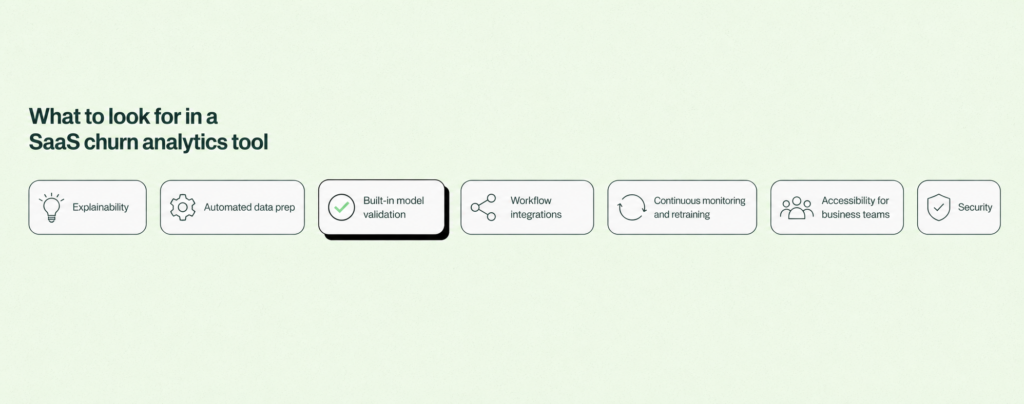
- Explainability: Your AI model needs to equip your teams with clear reasons behind each churn score, such as falling usage, rising support volume, or weak renewal signals.
- Automated data prep: The best AI predictive analytics tools take care of the messy cleanup and data joining across product, billing, CRM, and support — so you don’t have to.
- Built-in model validation: Your model should perform well enough before you move it to production, and the best modeling platforms in the market offer built-in validation to guarantee top performance.
- Workflow integrations: The churn prediction model should send scores right to your CRM, customer success platform, or warehouse where work already happens.
- Continuous monitoring and retraining: The best software will catch performance drift early and refresh your model as customer behavior changes. No need for manual tuning.
- Accessibility for SaaS business teams: A good AI for SaaS churn detection is one that analysts, CS, RevOps, and support teams can use without waiting on a full data science queue.
- Security: The safest AI tools for predictive customer analytics protect your client’s data with enterprise-grade controls, robust governance, and compliance with standards such as ISO 27001 and SOC 2 Type II.
Learn more about AI predictive modeling.
Best practices for reducing churn in B2B SaaS: 5 steps to prevent goodbyes
From learning to read the signs to retraining your predictive models, there are a handful of practices that will help you reduce churn in your B2B SaaS. Let’s explore them all:
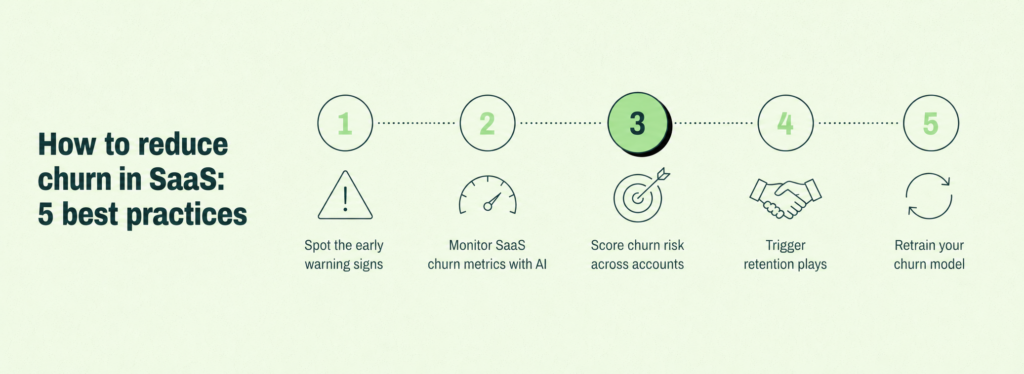
- Spot the early warning signs
No customer cancels a SaaS subscription for no reason. Pay attention to these common churn signals and trigger the recommended actions to avoid losing revenue:
| Warning churn signal | Data source |
| Declining product usage | Product analytics |
| Increased support tickets | Support platform |
| Negative customer feedback | CSAT, NPS, call notes |
| Missed renewal signals | CRM, contract data |
| Reduced engagement with new features | Product analytics, email campaign performance indicators |
- Monitor SaaS churn metrics with AI
We know you can measure subscription churn the old-fashioned way with spreadsheets. But the thing about using AI for this task is that the technology can monitor those metrics automatically and flag unusual changes faster than anyone ever could with manual reporting.
Here are the KPIs for predicting churn with AI:
| Key metrics | What it shows | How to measure | Best use case |
| Subscriber churn rate | Percentage of customers lost in a period | Customers lost ÷ starting customers | Track logo retention |
| Gross MRR churn | Revenue lost from downgrades and cancellations | Churned MRR ÷ starting MRR | Measure pure revenue loss |
| Net MRR churn | Revenue lost minus expansion revenue | (Churn + contraction – expansion) ÷ starting MRR | Show whether expansion offsets churn |
| Negative churn | Expansion exceeds lost revenue | Net MRR churn below 0% | Prove strong account growth |
- Score churn risk across accounts
Siloed reports from different teams won’t show you the whole picture about who’s about to churn. A healthy enterprise customer on an annual contract isn’t a good baseline for a small monthly customer still in onboarding, right? The best way out here is to score the risk of churning based on different categories:
- Account: Score each individual customer account on its own, based on that account’s behavior and risk signals only
- Segment: Group customers by shared traits, then look for churn patterns inside that group
- Plan: Divide customers based on the subscription tier or package they bought
- Lifecycle stage: Separate customers based on their position in the customer journey
Once you’ve sorted your clients, AI can connect the dots across usage, support interaction, billing, and CRM data, spotting patterns you might never see on your own.
- Trigger retention plays
The most important thing about churn prevention is what you can do to avoid the worst-case scenario. Here are the best plays to pull the trigger on your customer retention software:
| How to reduce churn in SaaS | What to do | Best for | Main goal |
| CS outreach | Reach out to the client with a tailored check-in, support plan, or business review |
| Rebuild engagement and solve issues before the account slips further |
| Onboarding support | Offer extra setup help, training, or guided onboarding steps |
| Help customers see value faster and reduce early-stage churn |
| Feature education | Show customers how to use underused features through emails, walkthroughs, webinars, or in-app guidance |
| Increase adoption and make the product more useful in day-to-day work |
| Renewal intervention | Step in before the renewal date with a review, success plan, pricing discussion, or risk-specific outreach |
| Protect renewals and address objections before cancellation becomes final |
| Save offers | Present a targeted offer such as a lower-tier plan, short-term discount, contract adjustment, or added support |
| Keep the customer in the fold, even if the account changes shape |
Explore retention analytics and strategies.
- Retrain your churn model as customer behavior changes
Customer behavior never sits still. Product adoption shifts, pricing pressure rises, support patterns change, and renewal behavior can look very different from one quarter to the next. If you keep using an old churn model, the predictions will become less accurate and miss new cancellation signals.
AI helps you retrain your churn predictive model faster by tracking performance over time, spotting drift in the data, and updating the prediction logic as patterns change. Keep an eye out for any alerts on your churn prevention software showing that you need to retrain your model. This update is the only way to keep churn scores relevant, so revenue and customer success teams can act on current risk instead of outdated assumptions.
Meet the best AI tool for predicting SaaS customer churn
Ready to make churn predictions an easy-peasy task? Pecan is your AI predictive tool for this mission. Join industry leaders reaching a 12% average churn reduction across retention use cases by getting models ready in a few weeks through our predictive AI agent.
With Pecan, you can:
- Ask churn questions in plain English
- Automate data prep and model building
- Validate predictions before deployment
- Push churn scores into business workflows
- Act faster without waiting for a full data science project
Book a demo to see Pecan in action.

Ori is a Customer Engagement Manager at Pecan AI, where he’s helped customers adopt predictive analytics from first demo to real business impact. He’s grown through Pecan support and customer success, wearing hats across CSM, solutions engineering, and customer onboarding, and turning complex ML concepts into simple, actionable workflows.