When delivering AI outcomes requires more time and resources than you can afford, it’s easy to feel stuck and miss out on new opportunities. But imagine making tools like predictive analytics accessible to the people who truly understand your organization. That’s the promise of low-code AI.
In this guide, we’ll show you how these intuitive platforms speed up results and empower your experts to make better, faster business decisions.
Key Highlights:
- Low-code AI is a software development process that uses visual interfaces and pre-built components to integrate and deploy AI capabilities without extensive manual programming.
- Benefits of low-code AI platforms include faster experimentation, rapid adaptation to market changes, improved productivity, cost-effectiveness, and simplified maintenance.
- To properly adopt a low-code AI software, you need to train and onboard teams, integrate the applications into your workflows, and measure the results.
- Pecan AI provides a low-code predictive analytics platform that transforms how businesses handle forecasts, allowing you to generate accurate predictions by simply describing business problems in plain English.
What Is Low-Code AI?
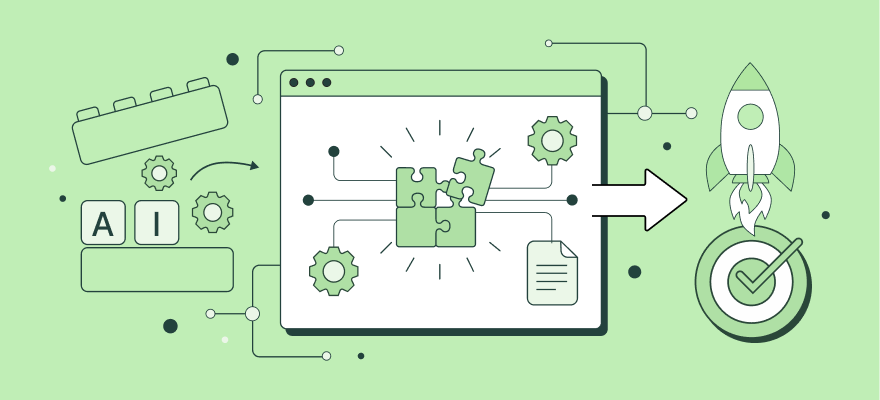
Low-code AI is a software development approach that uses visual interfaces and pre-built components as a shortcut for integrating and deploying AI capabilities, so developers don’t need to build machine learning models from scratch. Platforms that offer this facility let your team deploy apps or features without requiring developers to write extensive custom code. By minimizing time spent on infrastructure, your developers can concentrate on creating custom business logic.
From streamlining administrative tasks, such as automated data entry or report generation, to providing sophisticated predictive analytics, low-code artificial intelligence bridges the gap between technical and non-technical staff. Imagine that your own sales team can create a predictive model to forecast churn, helping them to approach high-risk customers before they run to the forest and never come back: It’s truly code-venient, isn’t it?

Understanding Low-Code Artificial Intelligence Tools
Low-code AI tools give businesses the flexibility to tailor solutions based on their unique needs and challenges. Because these tools require minimal dev skills, non-technical users can create and customize AI models without writing complex code.
Not every low-code tool serves the same purpose. Choosing the right one depends on whether you need to predict a number, generate a report, or automate a repetitive task.
Main categories of low-code technology include:
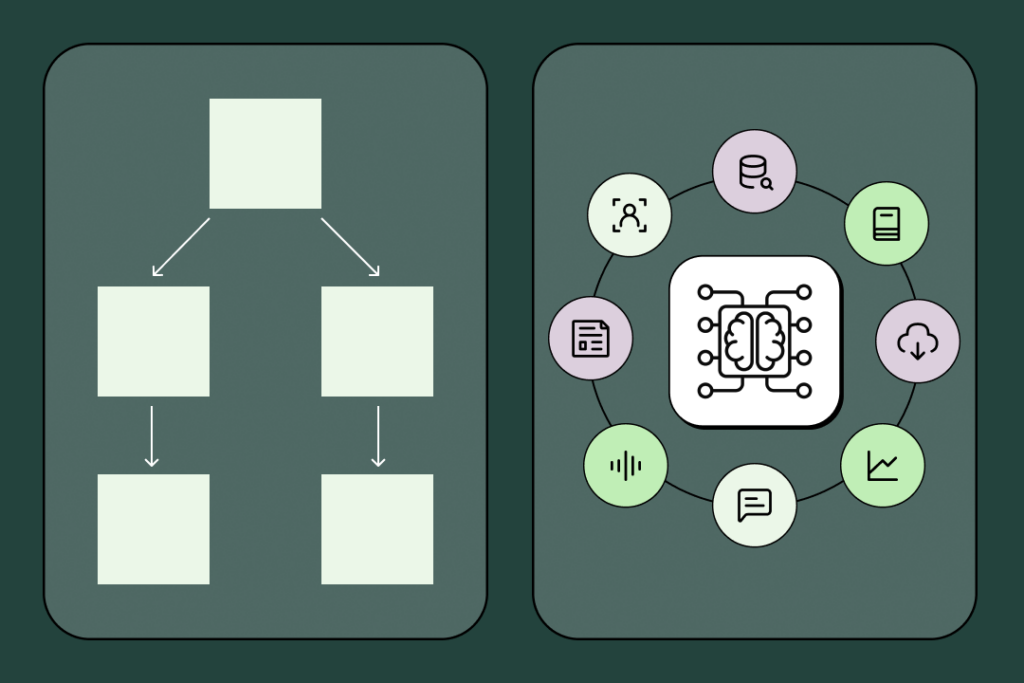
Predictive Analytics and Machine Learning Platforms
These tools focus on forecasting future outcomes based on historical data. They are designed to handle specific business questions like “Which customers are likely to leave next month?” or “What will our demand be within 14 days?”
- Core Focus: Classification, regression, and risk scoring.
- Process: Transforming your raw data into a model-ready input.
- Output: Precise predictions that plug into business workflows like a CRM or marketing dashboard.
AutoML and Model-Building Tools
AutoML platforms sit closer to the data science side of the house. They automate the selection and tuning of various algorithms to find the most accurate model for a dataset.
- Core Focus: Efficiency for technical users.
- Process: Automating hyperparameter tuning and model comparison.
- Output: Highly optimized models that still require some machine learning context to interpret correctly.
Workflow and Decision Automation Platforms
With production-focused solutions, AI is part of a broader automation system. Instead of just giving you a number, workflow and decision automation platforms take action based on it.
- Core Focus: Operational efficiency and “If-Then” logic.
- Process: Combining rules engines with AI models to trigger steps in a chain.
- Output: Automated workflows for finance, supply chain, or support systems.
Agent-Based Low-Code AI Tools
Think of agentic AI low-code solutions as an internal developer inside your systems. It will prep your data, ask you questions, and then come up with a feature, app, or entire machine learning model to help you achieve your business goals. The accessibility of these agents makes the power of AI usable for everyone, not just data scientists and tech-savvy people.
- Core Focus: Natural language goal setting.
- Process: Using an agent to prep data, generate features, or manage API calls.
- Output: A completed project where the user only defines the final objective.
Low or No-code Generative AI Builders
Often confused with predictive tools, low or no-code generative AI builders focus on creating new content. They are the engine behind the chatbots and writing assistants we see daily.
- Core Focus: Text, image, or content generation.
- Process: Prompt-driven builders that use Large Language Models (LLMs).
- Output: Creative assets, customer responses, or summary reports.
What Are the Benefits of Low-Code AI Tools?
Low-code AI tools offer scalability and flexibility that traditional AI development can’t. They allow for quicker model-building processes, such as creating and testing, leading to faster implementation.
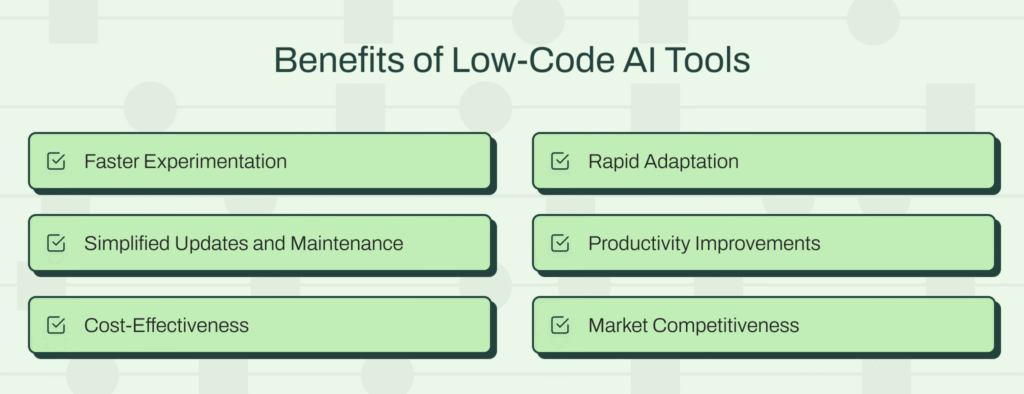
AI low-code solutions leverage intuitive interfaces, often integrated with generative or predictive AI, along with drag-and-drop features to offer you a handful of benefits, including:
- Faster Experimentation: Test different AI models using auto-generated or prebuilt components.
- Rapid Adaptation: Modify AI solutions to meet evolving business requirements.
- Simplified Updates and Maintenance: Make quick changes and modifications without editing extensive code, leveraging automated components like data connectors and data prep tools.
- Productivity Improvements: Spend more time on strategy and let AI handle the technical heavy lifting.
- Cost-Effectiveness: Deploy AI tools without expanding your team.
- Market Competitiveness: Develop features and products to stay ahead of competitors without writing thousands of lines of code.
Low-code AI puts the power directly in the hands of the people who know your business best. No more endless back-and-forth with outside consultants; your team can get hands-on with AI and make things happen faster.
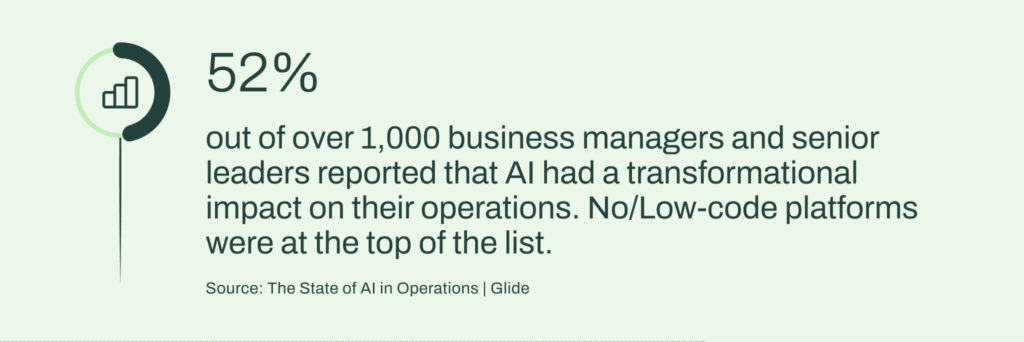
According to a survey by Glide, 52% of managers reported that AI had a transformational impact on their operations. No/low-code platforms were at the top of the list, proving to be the most impactful tools.
Low-Code vs. No-Code AI Development: Key Differences
Low or no-code development in generative AI is when developers use models such as ChatGPT, Claude, Gemini, or similar options to build and deploy business applications. These tools let devs use visual interfaces or natural language as an alternative to traditional programming. But even though people often lump these terms together, they’re designed for different types of users.
- No-Code AI: Tailored for business users with zero programming experience. These platforms use visual builders and pre-built templates to create models.
- Low-Code AI: Targeted for users with some technical expertise. These tools allow for minor coding tweaks to customize the AI performance or integrate it with complex systems.
An IDC report predicts that the number of low-code developers will jump by 16.3% by 2028, hitting 24.2 million worldwide. This shift shows that organizations are refocusing their development resources, expanding who can participate in building and deploying solutions, allowing business teams to turn ideas into production-ready applications more quickly.
Use Cases That Prove Everyone Can Adopt AI Low-Code Tools
From retail operations to manufacturing, there’s a handful of industries benefiting from low-code AI tools. Here are examples of successful projects:
- Retail: Low-code AI has enabled businesses to create personalized marketing campaigns and improve predictive inventory management in the retail industry, enhancing customer satisfaction and business profitability.
- E-commerce: By analyzing customer behavior, purchase history, and browsing habits, low-code AI tools can generate personalized product recommendations, leading to increased sales and customer satisfaction.
- Manufacturing: AI models can spot when equipment needs maintenance, so you avoid downtime and keep productivity high. Low-code tools also help manufacturers forecast demand, cut inventory costs, and deliver on time.
- Human Resources: AI can automate resume screening and schedule interviews, while predictive analytics in HR can help identify patterns that indicate employee churn, allowing proactive measures to retain talent.
- Finance: In the finance sector, low-code AI detects fraudulent activities, assesses credit risk, and enables many more financial benefits through predictive analytics.
- Logistics: By leveraging AI in their operations, logistics companies optimize transportation routes, reduce fuel consumption, and provide more accurate delivery estimates to customers.
- Insurance: AI tools help insurers analyze and predict what customers need next by analyzing their clients’ previous behavior.
Pecan customer Coinmama sought a low-code AI solution to help them combat chargebacks and detect fraudulent transactions efficiently. Initially reliant on manual SQL scripts, they transitioned to Pecan’s automated platform, empowering data analysts to create predictive models that assess transaction risk rapidly.
By automating the transaction risk evaluation, Coinmama significantly reduced review times, saving their payments team an average of 8 minutes per transaction and uncovering 15% more fraudulent activities than before. Using Pecan’s low-code AI platform ultimately saves time, cuts costs, and enhances their decision-making processes.
How to Adopt a Low-Code AI Platform
Using low-code AI tools helps businesses harness AI’s power without the limits of traditional development. Business and data teams can easily build, test, and deploy AI models for tasks like lead scoring, churn prediction, and workload routing.
Technavio predicts that the low-code AI platform market will grow at a 32.2% CAGR from 2024 to 2029, adding roughly $32.26B in new growth. That pace signals a fast-moving shift: teams that don’t catch up with the technology will fall behind competitors.
Here is how to onboard a new low-code AI solution in only three steps:
1. Train Data and Business Professionals
Onboarding to a low-code AI platform is less about coding and more about using the tool to solve real business problems. Start with short, role-based training for teams:
- Product and Ops: Define use cases and success metrics.
- Data and Analytics: Configure data sources and model logic.
- Business Stakeholders: Read outputs and act on insights.
Use guided tutorials to help users build simple models – for example, predicting form completions or routing tickets. The goal is to build confidence in how to create, adjust, and monitor AI models, not to turn everyone into engineers.
2. Integrate Low-Code AI into Existing Workflows
Adopting low-code AI in teams works best when you embed the technology in tools people already use. Connect your platform to:
- CRM and MAP for lead scoring and next-best-action.
- Support tools for ticket classification and prioritization.
- BI or predictive analytics tools for forecasting and anomaly detection.
Most tools offer native integrations and APIs, so you can plug models into current dashboards, forms, and automations.
3. Measure the Outcomes of Adopting Low-Code AI Tools
You’ll only know if the adoption of AI low-code agents was a success if you measure the results of using the technology. Wait a few weeks post-implementation and then focus on a few high-impact workflows – for example, sales qualification or support triage – and check for KPIs like:
- Time saved per task.
- Response and resolution times.
- Impact on revenue or customer satisfaction.
With focused training and a clear rollout plan, low-code AI agents integrate into workflows, reducing manual work and speeding up decisions.
Get Enhanced Predictive Analytics Powered by Pecan’s Low-Code Agent
Pecan provides business and analytics teams with a low-code AI tool for predictive modeling that actually works. We automate the entire forecast workflow, especially the messy, time-consuming data prep that usually stalls projects. Forget about wrestling with code; with Pecan, you just ask questions in plain English to generate production-ready models.
With Pecan, you can:
- Build and refine complex models by chatting with our AI assistant.
- Skip the manual wrangling with patented data engineering that preps your raw files automatically.
- View transparent SQL notebooks for every training set.
- Move from a business question to a live, production-ready model in days rather than months.
- Connect predictions directly to your warehouse, CRM, or marketing tools to trigger immediate action.
- Improve lead scoring to better target potential customers.
- Get multilevel demand forecasting.
Book a demo and see how Pecan makes predictive analytics easy for your business with a low-code AI platform.

Team Pecan is what happens when you put a bunch of data geeks in a room and tell them to make machine learning suck less. We’ve built models, broken models, fixed models, and occasionally questioned our life choices at 2am debugging feature pipelines. Now we write about it so you don’t have to learn the hard way. Think of us as your slightly unhinged data science friends who actually want you to succeed.