Here’s a question almost no team can answer about their lead scoring model: does the score actually predict who converts?

Not “does it feel right.” Not “did we all agree on the points in a meeting.” Does a lead that scores 90 close more often than a lead that scores 40, in your real data, over the last few quarters? Most teams have never checked. They built a model, wired it into the CRM, and trusted it the way you trust a clock you never compare against the actual time.
A lead score is a hypothesis. “Demo-requesters convert better than ebook-downloaders” is a claim about the world that your data can prove or embarrass. The most important step in building a lead scoring model isn’t assigning the points. It’s the audit you run afterward to see whether the points were ever right. This guide walks through building a model from manual rules to predictive ML, and it treats that audit as the main event, not a footnote.
What a lead scoring model is
A lead scoring model ranks leads by how likely they are to convert, so sales spends time on the ones most likely to close. You define scoring criteria, set thresholds that sort leads into tiers, and route each tier to the right follow-up.
Two kinds exist. Rules-based scoring, where a human assigns point values by hand. Predictive scoring, where a machine learning model learns the weights from your actual conversion history. Most teams start with the first. The good ones eventually graduate to the second, usually after the audit shows them why.
One thing worth settling before you build: the signals that matter depend heavily on your motion. A B2B sales-led model leans on firmographics and high-intent actions like demo requests and pricing visits, because a human rep is the conversion path. A product-led or B2C model leans far more on in-product behavior, activation milestones, feature adoption, usage frequency, because the product itself does the converting. Copying a B2B template into a self-serve business is one of the quieter reasons scoring models underperform. Build for how your customers actually buy, not how the last company you worked at did.
How to build a rules-based model
Rules-based scoring is a fine place to start, especially if you’re early and your volume is low. Five steps get you a working version.
Step 1: Define your conversion event. Decide what counts as a win. A closed-won deal, a booked demo, a completed signup. Everything downstream measures against this, so pick the event that actually matters to revenue, not a soft proxy like “opened three emails.”
Step 2: List your scoring signals. Split them into two buckets. Demographic and firmographic signals describe who the lead is: job title, company size, industry. Behavioral signals describe what they did: pages visited, emails opened, pricing page views, demo requests.
Step 3: Assign point values. Weight each signal by how strongly you believe it correlates with conversion. This is the step everyone does on instinct, and it’s the step the audit will later put on trial.
Step 4: Set thresholds. Group scores into tiers. Hot, warm, cold. The cutoffs decide who gets a fast sales touch and who gets nurtured.
Step 5: Route by tier. Send hot leads straight to sales, warm leads to nurture, cold leads to automated follow-up.
A worked example, with numbers, so this isn’t abstract. Say you’re scoring B2B leads:
- VP or C-level title: +20
- Company size 200+ employees: +15
- Visited pricing page: +25
- Requested a demo: +30
- Downloaded a top-of-funnel ebook: +5
- Email address is a free domain (gmail, yahoo): -15
A lead who’s a VP at a 500-person company, visited pricing, and requested a demo scores 90. Hot. A gmail user who downloaded one ebook scores -10. Cold. Set your hot threshold at 70, your warm at 30, and you’ve got a routing system you can ship this afternoon.
It works. For a while.
Where rules-based scoring breaks
Rules decay, and they decay quietly.
The signals that correlated with conversion last quarter may not hold this quarter. Your market shifts, your product changes, a new competitor reshapes who buys. The points stay frozen while reality moves. Worse, a human can only juggle so many signals at once. You weighted six or eight things by hand. Your data has hundreds of weak signals that interact in ways no person would ever map, and your rules ignore every one of them.
Then there’s the bias problem. Rules encode what you already believe converts. If you’re wrong about the VP title mattering more than the pricing-page visit, the model doesn’t correct you. It amplifies your assumption and feeds it to sales as fact. The model becomes a confident mirror of your blind spots.
None of this announces itself. The scores keep flowing. Sales keeps working the list. The only way to catch the rot is to look.
Three mistakes that make rules-based scoring worse than no scoring
While we’re here, the failure modes worth naming. Teams rarely build a bad model on purpose. They build one of these by accident.
First, scoring on activity instead of intent. A lead who opens twelve emails looks engaged and might just be on a competitor’s research team. Volume of activity and likelihood to buy aren’t the same thing, and rules that reward raw activity inflate the wrong leads to the top.
Second, never using negative scores. Plenty of signals should subtract. A free email domain, a student title, a job board referral. A model that only adds points treats every lead as a stack of positives and quietly buries the disqualifiers.
Third, setting it and forgetting it. A rules model needs a review cadence, quarterly at least. The teams that get burned are the ones who built a model in a strong quarter, never revisited it, and kept routing leads on logic that expired two product launches ago.
Put your model on trial
This is the step almost everyone skips, and it’s the one that earns the whole exercise.
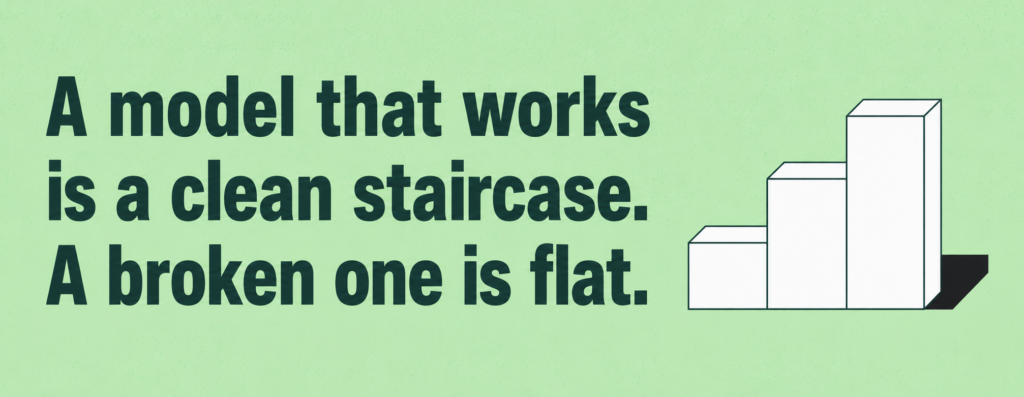
Take your last few quarters of leads. Pull their scores, and pull what actually happened to them. Then sort. Of the leads that scored hot, what percentage converted? Of the ones that scored cold, how many closed anyway, slipping past your model entirely? Plot conversion rate against score band. A model that works shows a clean staircase, conversion climbing with score. A model that’s broken shows a flat line, or worse, a few cold leads converting at the same rate as your hot ones.
Put numbers on it so you know what you’re looking for. A healthy model might show hot leads converting at 18%, warm at 7%, cold at 1.5%. That’s a staircase you can route on with confidence. A broken model shows hot at 9%, warm at 8%, cold at 7%, three tiers that barely differ, which means your score is sorting leads into bins that don’t predict anything. If your hot tier and your cold tier convert within a couple of points of each other, the score isn’t doing its job, no matter how reasonable the points looked on paper.
When I’ve run this with teams, the flat spots are where the conversation gets interesting. A signal everyone swore by turns out to predict nothing. A throwaway behavior nobody weighted turns out to separate buyers from browsers. That’s not a failure of the team. It’s the cost of weighting signals by intuition instead of evidence, and it’s exactly the gap predictive scoring closes.
If your staircase is clean and your volume is modest, keep your rules. Seriously. Not every team needs ML. But if the audit shows your scores and your outcomes have drifted apart, the points aren’t worth patching by hand again. That’s the signal to graduate.
How predictive lead scoring works
Predictive lead scoring runs that audit automatically, every time, because the model is built from outcomes rather than opinions.
Instead of you guessing weights, the model trains on your actual conversion history. It ingests every signal available, the hundreds you’d never weight by hand, and learns which ones, in which combinations, separated the deals that closed from the ones that didn’t. The output is a probability per lead, grounded in what really predicted conversion in your data, not what someone assumed in a planning meeting two years ago.
This is where Pecan fits. You connect your CRM data, define the conversion target, and the platform builds and validates the model on your history. The validation step is the audit, baked in. The model only ships if it actually predicts. For the deeper background, our guides on AI lead scoring and predictive analytics cover how the underlying predictive modeling works.
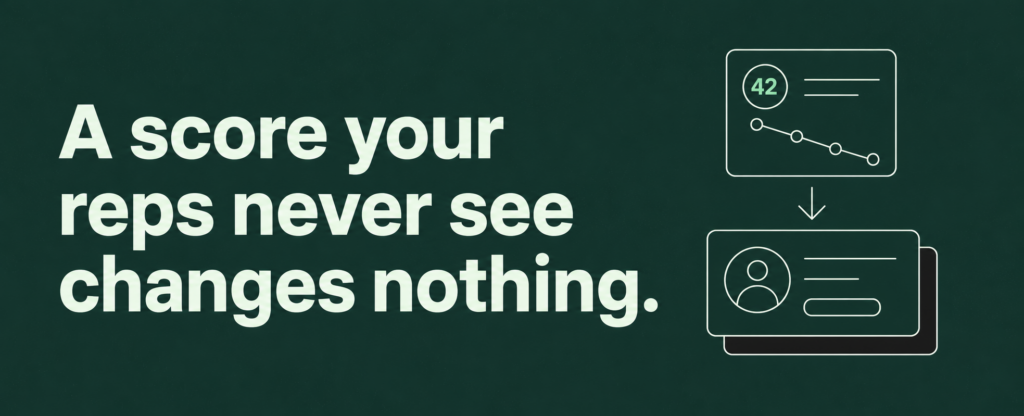
A practical note on the handoff, because this is where rollouts stall. A predictive score is only worth building if your reps can see it where they already work. A probability locked inside a separate analytics tool gets ignored. The same score written back into the lead record in your CRM, sitting right next to the contact info a rep is already looking at, gets used. When you evaluate predictive scoring, treat the writeback into Salesforce or HubSpot as non-negotiable, not a nice extra. The best model in the world changes nothing if the person making calls never sees its output.
Rules-based vs. predictive: a side-by-side
| Rules-based | Predictive | |
| Accuracy | Depends on your assumptions | Learned from actual outcomes |
| Signals weighed | A handful, by hand | Hundreds, automatically |
| Maintenance | Constant manual retuning | Retrains on new data |
| Bias | Encodes your beliefs | Surfaces what data shows |
| Time to build | An afternoon | Days |
| Scales with volume | Poorly | Well |
If you’re shopping for the software side of this, our breakdowns of lead scoring software and the best lead scoring tools compare the options.
Where to start
If you’re handling fewer than a hundred leads a month, build the rules-based model. It’s fast, it’s free, and at that volume the precision of ML won’t change a single rep’s day.
The moment your audit shows the scores and the outcomes have come apart, or the moment your volume outgrows what one person can tune by hand, that’s your cue. Don’t rebuild the rules for the third time. Build a model that scores itself against reality and retrains when reality moves.
Either way, run the audit. A lead score you’ve never checked against your own conversions isn’t a model. It’s a guess with good posture. And the teams that win at this aren’t the ones with the most elaborate scoring logic. They’re the ones who keep asking the uncomfortable question, week after week: is this score still telling us the truth about who buys?
Build your predictive lead scoring model with Pecan.

Asaf is the Head of Customer Success at Pecan AI, where he helps enterprise customers turn predictive analytics into real, measurable business outcomes. He’s grown through Pecan from AI Success Manager to Team Lead to Director, bringing a strategic consulting background and an Economics degree from the Hebrew University of Jerusalem (plus a serious scuba diving habit).