In a nutshell:
- Poor customer experiences could put $3.8 trillion in global revenue at risk by 2025. Yeah, you read that right. Trillion with a T.
- Customer churn prediction software spots at-risk customers before they ghost you, so you can actually do something about it.
- Top picks for 2026: Pecan, Gainsight, Zendesk, ChurnZero, and Churnly (among others). They range from AI-powered prediction platforms to customer success tools.
- When shopping around, look for easy interfaces, solid data connections, AI/ML smarts, scalability, and clear ROI. The right tool should fit your stack and deliver insights you can actually use.
- Using predictive analytics for customer success can seriously boost retention and inform smarter marketing. Predictive models help you target the right interventions and keep customers happy.
Why customer churn prediction matters (and why you should care)
Here’s a fun fact that’s not actually fun: organizations worldwide are risking about 6.7% of their revenue to churn caused by bad customer experiences. That’s roughly $3.8 trillion in lost sales just… disappearing.
No one wants to watch valuable customers quietly slip away. Yet churn happens across every industry, whether you’re in SaaS, e-commerce, telecom, or banking. It’s like trying to fill a bucket with a hole in it.
But here’s where it gets interesting. Instead of waiting until customers have already left (awkward), you can use data and analytics to predict who’s most likely to bail. Then you can actually do something about it. Spot the early warning signs (declining usage, support complaints, that weird feeling when someone stops opening your emails), and you’ve got time to re-engage them with targeted campaigns, special offers, or just fixing whatever’s bugging them.
Preventing customer attrition pays off big time. When customers leave, you’re not just losing their revenue. You’re also facing the brutal cost of replacing them. It’s widely cited that acquiring a new customer costs 5 to 7 times more than keeping an existing one. Ouch. Plus, high churn damages your brand reputation because unhappy customers love sharing their experiences online. In contrast, happy customers stick around, spend more, and might even tell their friends nice things about you.
That’s why churn prediction is genuinely important. It lets you see what’s coming and address issues before customers walk out the door. In a world where the average annual churn rate in SaaS companies hovers around the low-to-mid teens, and some industries see churn rates above 20%, being proactive isn’t optional anymore. For example, B2B SaaS averaged around 12.5% churn in 2025, while consumer-facing sectors like telecom regularly report around 25% churn. Hospitality and travel? Sometimes approaching 45% of customers in a year. Every percentage point you reduce churn directly protects your revenue and growth.
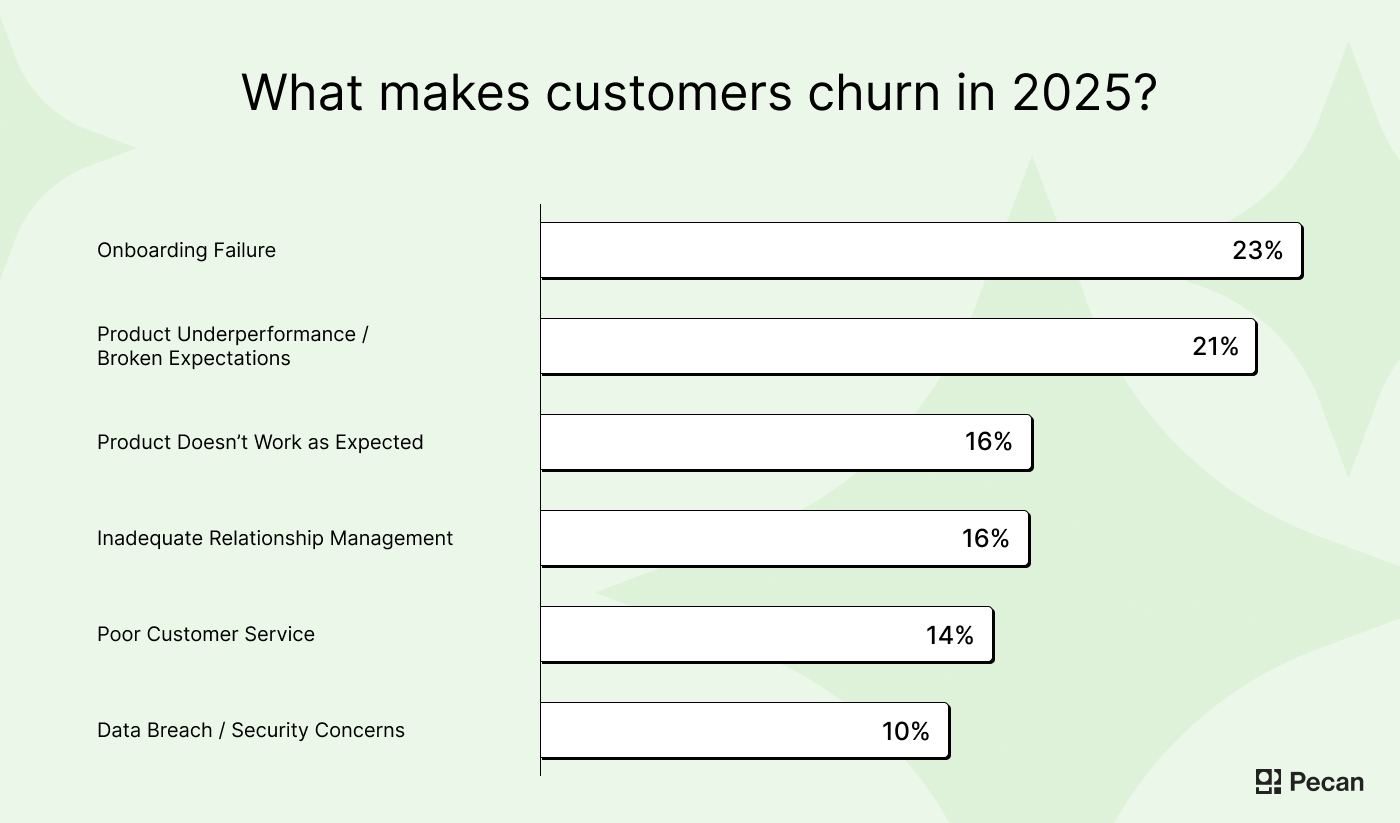
So what makes customers churn? One recent analysis found that over 53% of churn comes down to just a few culprits: bad onboarding (23% of churn), inadequate relationship management (16%), and poor customer service (14%). In other words, how you welcome, support, and engage customers plays a massive role in whether they stay or go.
Product issues are another major driver. About 31% of consumers say they’ve left a brand due to false promises about product performance, and 23% have churned because the product simply didn’t work as expected. Even data breaches or security issues can cause around 15% of customers to flee.
With predictive churn analytics, you can shine a light on these patterns in your own business. Which customers are struggling with onboarding? Who’s frustrated with support? Are certain features causing headaches? Answer these questions early, and you can step in before customers decide to leave. It’s way more effective (and cheaper) to prevent churn than to try winning someone back after they’re gone.
What is customer churn prediction software?
Customer churn prediction software uses data and machine learning to proactively identify customers at risk of leaving. These tools analyze a wide range of signals (purchase history, product usage, support interactions, surveys, subscription data, you name it) to detect the warning signs that often show up before churn happens.
By processing large datasets and finding patterns humans might miss, churn prediction software generates a “churn risk score” or alert for each customer or account. A high risk score means the customer is likely to churn if you don’t take action.
Think of it as an early warning system. Simply tracking your churn rate after people have already left isn’t enough. Modern solutions often use AI to continually improve predictions. Some platforms use natural language processing to gauge customer sentiment from support tickets or reviews, or time-series analysis to spot declining engagement. The result? Predictive insights your customer success, marketing, or account teams can actually act on to improve retention.
Here’s the best part: churn prediction tools don’t just flag at-risk customers. Many also help you take action. They integrate with CRM systems, marketing automation, email platforms, or in-app messaging, so you can automate targeted outreach to at-risk users. The goal isn’t prediction for prediction’s sake. It’s enabling timely interventions that actually reduce churn. By combining data-driven predictions with personalized customer engagement, you can dramatically increase retention rates and save significant revenue.
What to consider when choosing customer churn prediction software
Not every churn prediction tool is a winner (shocking, I know.) When you’re trying to find the best fit, here’s what to keep in mind:
Data Integration & Coverage: The software needs to hook up smoothly with your important data sources. Think product databases, CRM systems, billing platforms, support desks, and survey tools. The more complete the data, the better the predictions. Look for built-in integrations or APIs that work with your databases and business applications, like Salesforce, Snowflake, Shopify, Zendesk, and HubSpot. This ensures the churn model can access all the signals across the customer journey.
Ease of Use & Speed to Value: Your team shouldn’t need a PhD in data science to use the platform. Leading churn prediction software now offers no-code or low-code model building, intuitive dashboards, and clear visualizations of churn drivers. This shortens training time and helps you see value within weeks, not months. Fast setup and an intuitive UX will maximize adoption by your customer success or marketing team.
AI/ML Capabilities: The best solutions leverage machine learning and even generative AI to analyze complex datasets and identify subtle churn signals. AI-driven tools can automatically fine-tune prediction models, handle unstructured data like text, and continuously improve accuracy over time. Some churn software uses AI to analyze 100% of support interactions and pinpoint dissatisfaction cues. Evaluate whether a platform offers advanced analytics like predictive scoring, customer health indices, or even conversational AI assistants to help explore the data.
Scalability & Performance: As your business (and data) grows, the software must scale with you. Ensure the platform can handle increasing customer volumes and data records without slowing down. Cloud-based SaaS churn solutions are ideal for scalability since they can process millions of rows and retrain models as your dataset expands. Also consider if the pricing model will scale affordably as you add more customers or users.
Actionability & Integrations: Prediction is step one. Taking action is step two. Look for features that let you operationalize churn insights. Useful capabilities include automated alerts (like notifying reps when an account’s risk score worsens), built-in campaign tools to trigger win-back offers or in-app messages, and integration with communication channels (email, SMS, app notifications). Some churn platforms integrate with customer engagement tools so you can directly launch a retention campaign for a high-risk segment.
Security & Compliance: Since churn models use sensitive customer data, robust security is a must. Enterprise-grade solutions should offer encryption, access controls, and compliance with privacy regulations (GDPR, CCPA, etc.). If you’re in a regulated industry, make sure the vendor meets those requirements.
By weighing these criteria, you can choose churn prediction software that fits your organization and empowers your team to proactively retain more customers.
Top 10 customer churn prediction software in 2026
Ready to dive into the options? Here’s a rundown of the 10 best churn prediction software tools as of 2026. These will help you understand customer behavior, generate actionable insights to lower churn, and improve retention rates. We’ve included a mix of AI-powered analytics platforms and customer success software, prioritizing SaaS solutions that are practical for modern businesses.
Quick Comparison Table
| Software | Best For | Notable Features |
| Pecan AI | Automated predictive modeling for churn | No-code AI agent; fast model deployment; robust data integration |
| Gainsight | Enterprise customer success teams | Health scoring; lifecycle analytics; ML-driven risk alerts |
| Zendesk | Support-driven churn management | AI sentiment analysis; “Spotlight” issue detection; omnichannel CX insights |
| ChurnZero | B2B SaaS customer success (CSMs) | Customer health scoring; usage analytics; automated playbooks |
| Churnly | Churn risk scoring for SaaS (SMB to mid-market) | AI churn risk scores; revenue at-risk tracking; segment-based campaigns |
| Hotjar | UX/UI-focused churn reduction (web/apps) | Session recordings & heatmaps; user feedback polls; conversion funnels |
| Qualtrics XM | Voice-of-customer and feedback-driven churn | NPS/CSAT tracking; journey analytics; predictive churn modeling from surveys |
| Vitally | Product-led startups & CS team collaboration | Real-time health scores; customer engagement workflows; team collaboration tools |
| Akkio | Easy AI modeling for churn (no-code ML) | Auto ML model builder; churn risk scoring; also does lead scoring & forecasting |
| Retently | Subscription businesses focusing on NPS/CSAT | ML-based customer health scores; churn prediction from feedback; targeted retention campaigns |
#1 Best For Automated predictive modeling for churn – Pecan AI

Why Pecan: Pecan is a powerful predictive analytics platform that makes advanced churn modeling accessible, even if you don’t have a data science team. Pecan uses automated machine learning to analyze your historical customer data and build accurate churn prediction models with minimal effort.
In 2026, Pecan introduced a predictive modeling AI agent that uses conversational AI to help business analysts craft models and uncover insights without writing code. This means your BI or marketing team can quickly train machine learning models to forecast churn, conversion, lifetime value, and more, all through an intuitive interface.
Under the hood, Pecan automates complex tasks like data prep, feature engineering, and model tuning. The wellness brand Hydrant, for example, used Pecan to ingest years of purchase data and had a custom churn model built in just two weeks. With Pecan, you can segment customers by churn risk and understand why they might churn, enabling highly targeted retention campaigns. The system continues learning from new data, so predictions stay accurate over time.
Integrations: Pecan easily connects to your existing data stack with built-in integrations to over 15 databases, data warehouses, and business applications, from Amazon Redshift and Snowflake to Salesforce and HubSpot. You can also upload CSV files or connect via API. This flexibility means Pecan can pull in transactional data, product usage logs, marketing touches, and more to create a complete picture of each customer. The platform’s data pipeline will automatically cleanse and prepare the data for modeling.
Pricing: Pecan is offered as a SaaS product with tiered plans. As of 2026, pricing starts at around $760 per month for the Starter plan (when billed annually), which includes a set number of prediction runs and data storage up to a certain row count. Higher-tier plans (Team, Business) support more users, larger data volumes, and additional features, scaling up to a few thousand dollars per month. Pecan offers a free trial so you can evaluate the platform with your data. Enterprise plans are available for organizations with advanced needs.
What it’s great at:
- No-code predictive modeling: Pecan’s co-pilot and automated ML allow users to build churn models without coding expertise, enabling fast adoption by analysts and marketers.
- Rapid time to value: Models can be deployed in weeks. Pecan’s automated data prep and training shorten the usual AI development cycle dramatically.
- Scalability: The platform can handle small startups to Fortune 500 enterprises. It’s cloud-based and scales to billions of data rows, so growing customer datasets aren’t an issue.
- Flexible integration & deployment: Pecan can deliver predictions directly into your tools (send churn risk scores back to your CRM or data warehouse) and supports batch or real-time prediction updates.
- Continuous improvement: The AI continuously retrains and improves models as new data comes in, keeping churn predictions accurate as customer behavior evolves.
Areas of limitation:
- Pecan’s out-of-the-box integrations, while numerous, may not cover every data source. If you have very custom databases, you might need to use their API or export data to a supported format.
- Like any AI platform, you need sufficient data and knowledge of your data schema. Pecan simplifies a lot, but ensuring enough input data is still key for best results.
- Pecan is a broad predictive analytics tool. For organizations seeking a lightweight churn-specific tool or those that prefer a built-in CRM module, Pecan’s comprehensive approach might feel like more platform than you need (though the flip side is it can tackle many predictive questions beyond churn).
#2 Best for Enterprise CS teams with dedicated operations resources – Gainsight
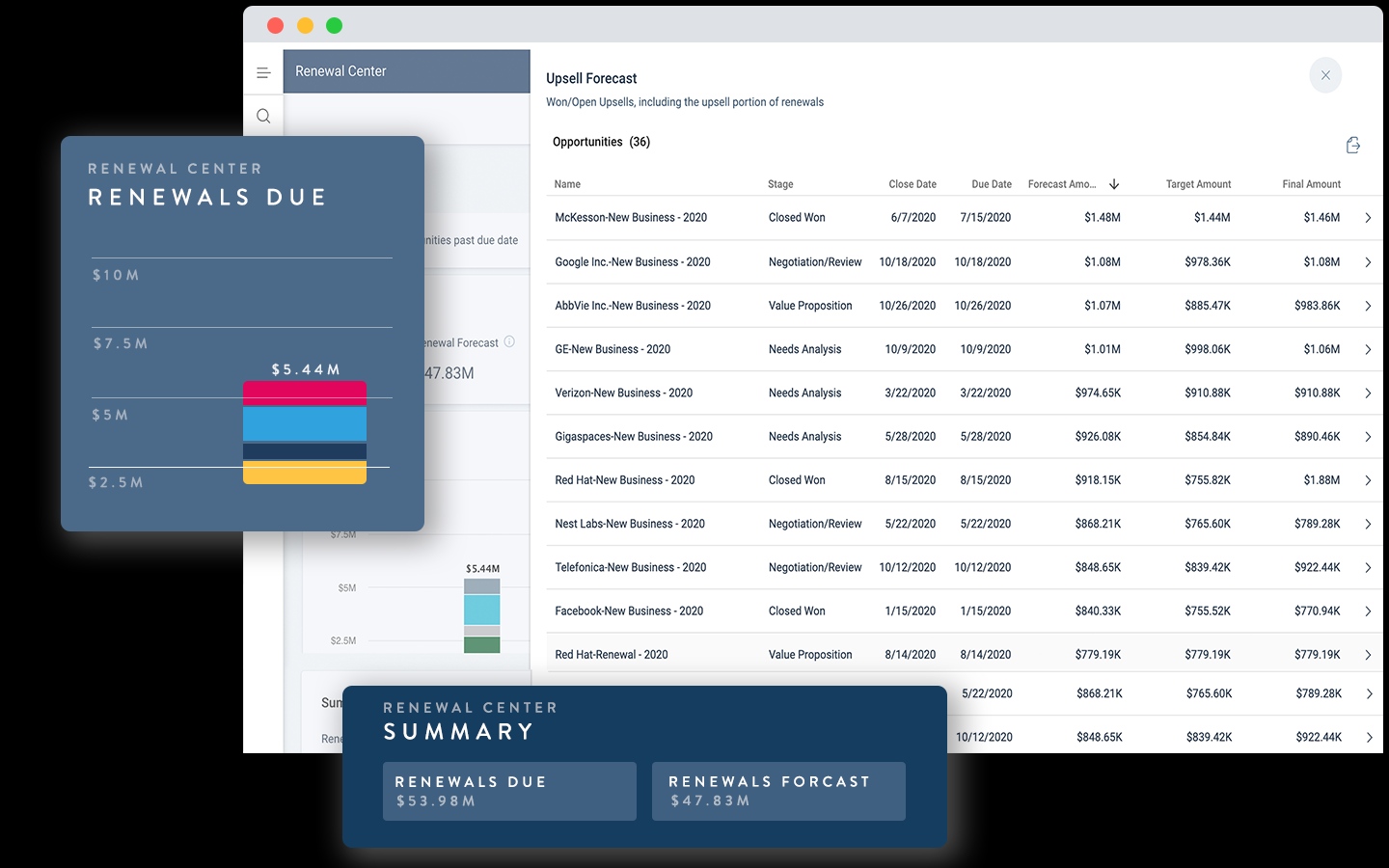
Why Gainsight: Gainsight is the enterprise heavyweight of customer success platforms, holding the #1 Leader position in the 2025 Gartner Magic Quadrant. It serves over 3,500 companies, including nearly 200 publicly traded organizations, with the most comprehensive churn prediction capabilities available.
Gainsight uses configurable health scorecards that aggregate signals from product usage, support activity, sentiment data (NPS, CSAT), engagement metrics, and financial indicators. Admins assign custom weights to produce composite health scores. Beyond rule-based scoring, machine learning optimization auto-tunes models based on historical outcomes.
The game-changer is the Staircase AI integration (acquired August 2024), which automatically scans all customer communications using AI to detect sentiment shifts, competitive mentions, and relationship deterioration up to six weeks earlier than product usage data alone. When risk signals surface, automated playbooks and the Journey Orchestrator trigger multi-step intervention campaigns.
Integrations: Exceptionally deep Salesforce integration (the strongest of any CS platform). Native CRM connectors for HubSpot, Microsoft Dynamics 365, Zoho CRM, and Pipedrive. Support tools include Zendesk, Freshdesk, and ServiceNow. Slack and Jira for collaboration. Notably, no native connectors for Snowflake, BigQuery, or Redshift (requires S3 or third-party ETL).
Pricing: No public pricing. Based on Vendr data from 292 purchases, median annual contract is $50,125 (range: $13,871–$194,409). Year 1 total cost including implementation and admin FTE: $90,000–$140,000. No free trial.
What it’s great at:
- Most comprehensive churn detection: Combines usage, support, sentiment, communication intelligence, and relationship mapping. Unmatched signal breadth.
- Deepest Salesforce integration: Real-time bi-directional sync with native Lightning components.
- Advanced automation: Best-in-class journey orchestration for intervention campaigns.
- Enterprise-grade: Handles massive scale with top security and compliance certifications.
- Strongest analyst positioning: #1 Leader in Gartner and Forrester.
Areas of limitation:
- Long implementation: 3–6 months typical, some deployments take nearly two years.
- Requires dedicated administrator: Complex configuration and ongoing maintenance demand technical expertise.
- Steep learning curve: G2 reviews consistently cite complexity and dated UI.
- High cost: Median $50K+ annually plus implementation and admin headcount. Overkill for smaller companies.
No native data warehouse connectors: Missing first-party Snowflake, BigQuery, and Redshift support.
#3 Best For Churn Risk Scoring for SaaS (SMB to mid-market) – Churnly
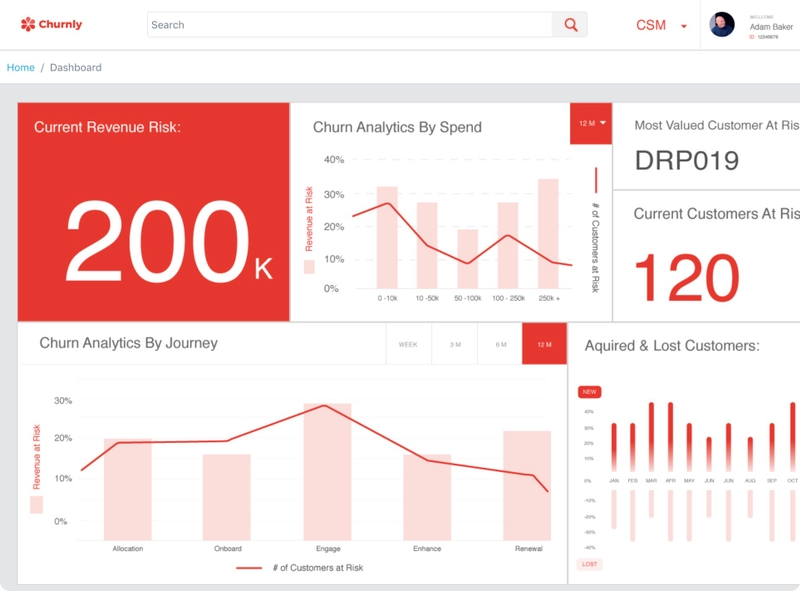
Why Churnly: Churnly is an AI-powered tool geared specifically towards predicting and preventing churn in subscription businesses (especially B2B SaaS). It’s designed to surface churn risk scores for each customer so your team can focus on the most at-risk accounts. Churnly analyzes customer data (usage activity, support tickets, billing and payment history, etc.) to identify patterns that often precede churn. A drop in logins or a spike in support issues raises a customer’s risk score.
Beyond prediction, Churnly provides a dashboard for customer success teams to take action on churn risks. You can set up alerts or playbooks when certain risk thresholds are met. Churnly also helps segment your customer base (by risk level, plan, or behavior) so you can run targeted retention campaigns for each segment. In-app engagement features let you trigger messages or offers to users who appear disengaged.
Integrations: Churnly offers integration with a focused set of tools commonly used in SaaS. It can connect with CRMs like HubSpot and Zoho, support platforms like Zendesk, and payment systems like Stripe. This covers many core systems for a typical subscription business. The range of integrations isn’t as extensive as some larger platforms. If you use less common tools, you may need to import data manually.
Pricing: Churnly’s pricing is not publicly listed. You’ll need to contact their team for a quote. Third-party sources indicate it may offer tiered pricing based on number of users or customers monitored (one source cited around £149 per user/month as a starting point), but this could vary. Churnly does not offer a free trial as of last check, but they might provide a demo or pilot program.
What it’s great at:
- Purpose-built for churn: Everything in the product is tailored to churn prediction and prevention. No unnecessary bells and whistles.
- Churn risk alerts: The software can send proactive alerts when an account’s metrics indicate trouble, helping your team intervene in real time.
- Account tracking and health scores: Churnly provides an easily digestible health score for each customer, great for account reviews and prioritizing outreach.
- Lightweight and SaaS-friendly: A cloud solution ideal for small-to-mid SaaS companies that need churn analytics without a heavy IT project.
- Mobile support: Churnly offers mobile app access, so you can keep an eye on customer health on the go.
Areas of limitation:
- Limited integrations compared to larger platforms. If you rely on a data source Churnly doesn’t support, you may need workarounds.
- As a newer player, Churnly might lack some advanced features or polish. Customer support is currently email-only and their desktop app is Windows-only.
- Unknown scalability for enterprise-scale companies with millions of users.
- No free trial means you have to commit to a pilot or contract to evaluate it.
#4 Best For Voice-of-customer and feedback-driven churn – Qualtrics XM
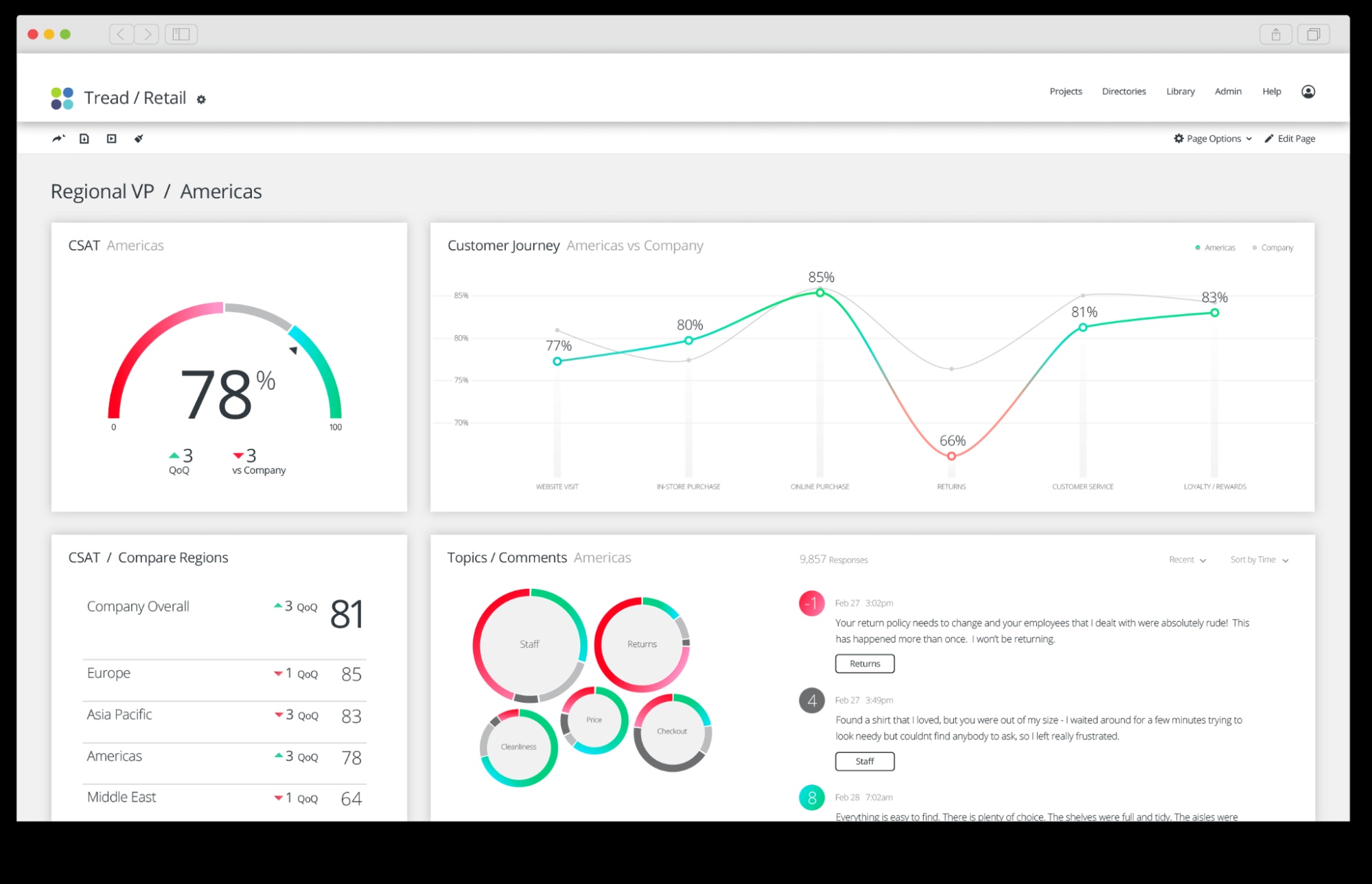
Why Qualtrics: Qualtrics XM (Experience Management) is a leading platform for understanding and improving customer engagement. It plays a strong role in churn prediction by focusing on customer feedback and sentiment. While Qualtrics is best known for surveys and Net Promoter Score (NPS) capabilities, it also includes analytics to identify customers at high risk of churn.
Qualtrics collects signals like NPS responses, CSAT scores, support feedback, and product usage data, then uses these to pinpoint unhappy customers who might leave. Its NPS feature helps you track follow-up with detractors (low scorers) in real time, since those are likely churn candidates.
Qualtrics XM leverages machine learning on combined operational and experience data to predict churn risk and suggest next steps. The platform can automatically flag when a customer’s feedback metrics deteriorate and create tasks for your team to intervene. A big strength is “closing the loop” on feedback: it provides tools to gather customer input and take action. If a customer gives a poor satisfaction rating, it can trigger an alert or email to a manager to reach out and remedy the situation.
Integrations: Qualtrics is built for enterprise environments, so it integrates with many business applications. It can sync data with CRM systems (like Salesforce), customer databases, help desk software, and collaboration tools like Slack or Trello. Feedback and churn indicators flow to where your teams work. Qualtrics also has APIs to pull in data from virtually anywhere and push out alerts. Integration breadth is one of Qualtrics’ strong suits.
Pricing: Qualtrics pricing is custom-quoted and not publicly disclosed. As a high-end solution, it is generally one of the more expensive options on this list, often packaged as an enterprise SaaS license. Costs depend on the number of users and survey responses or modules you need. Expect to engage with their sales team to scope your needs and get a quote.
What it’s great at:
- Voice-of-customer analytics: Qualtrics excels at capturing customer sentiment via surveys, reviews, and more, giving rich qualitative context to churn risk.
- NPS and feedback loop: Top-notch for NPS programs. It can identify detractors and help convert them by automating follow-ups and escalation workflows.
- Multi-channel insights: Qualtrics gathers data from websites, mobile apps, email campaigns, contact centers, and more. It offers a unified view of customer health across channels.
- Global and scalable: Supports many languages with robust security and compliance, making it suitable for large global companies.
- Actionable dashboards: Highly customizable dashboards can be configured for different roles.
Areas of limitation:
- No out-of-box “plug and play.” To use it for churn prediction, you’ll need to design the program (surveys, metrics, triggers) to fit your business.
- Less focus on product usage data. If your churn signals are mostly in product usage, Qualtrics might need to be paired with other tools.
- Can be pricey, potentially overkill for smaller companies.
- Cloud-only, no on-premise option.
- Learning curve due to depth of features.
#5 Best For UX/UI-focused churn reduction (web/apps) – Hotjar
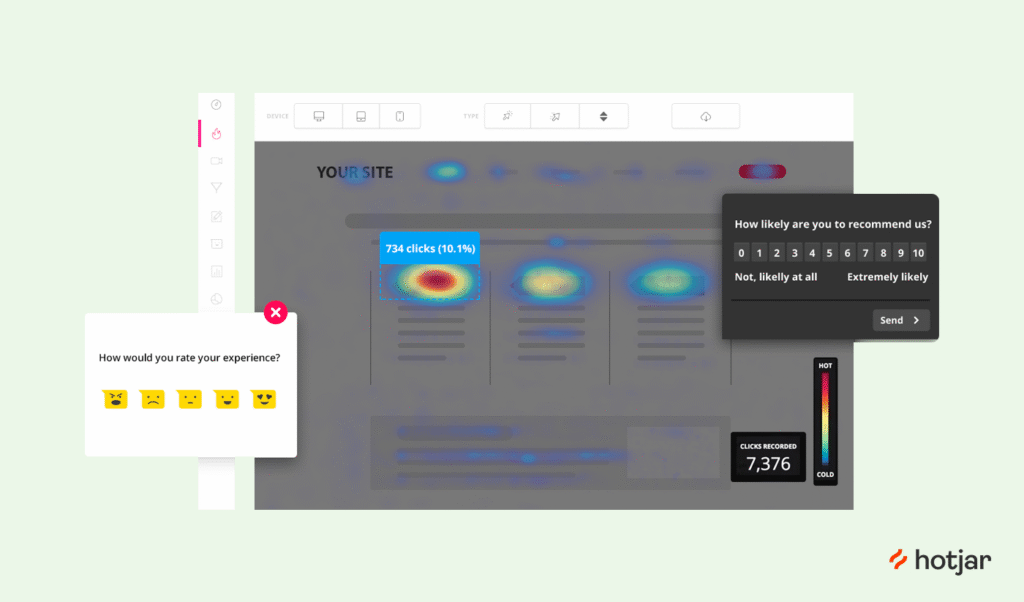
Why Hotjar: Hotjar takes a different angle on churn prediction. It’s a popular user analytics and feedback platform that helps you understand website and product experience, which is often directly linked to churn. Hotjar isn’t a churn scoring tool per se. Instead, it equips you with visual and behavioral insights to identify where users get frustrated or disengaged in your digital product.
Hotjar’s signature feature is session recordings. You can watch real recordings of users interacting with your website or app, seeing exactly where they click, scroll, or hesitate. If customers consistently struggle on a particular page or drop off at a certain step, that’s a churn risk indicator.
Hotjar also provides heatmaps and click maps that aggregate user behavior data, showing which parts of a page get attention and which get ignored. Areas of low engagement could signal confusion or lack of value. Additionally, Hotjar has built-in survey and feedback tools (on-site polls or feedback widgets) to capture users’ thoughts in the moment. While Hotjar doesn’t output a churn probability score, it gives qualitative and quantitative data that product managers and marketers can translate into churn reduction strategies.
Integrations: Hotjar is relatively easy to implement (typically you just add a snippet to your site). It offers integrations with a variety of tools, including Google Analytics, popular CMS and e-commerce platforms (Shopify, WordPress, etc.), and product analytics tools via Segment. You can pipe Hotjar feedback into Slack or product management tools like Jira. Through Zapier, Hotjar can be linked to thousands of apps.
Pricing: Hotjar uses a freemium model. There’s a Free plan with basic features (limited recordings/heatmaps per day). Paid plans start at $32 per month (billed annually) for the Plus plan. The Business plan scales with the number of daily sessions you want to record. For large volumes, Hotjar has Scale plans with custom pricing. A 30-day free trial of paid features is available. Overall, Hotjar is fairly affordable, especially compared to enterprise churn tools.
What it’s great at:
- User behavior insights: Gives you an unparalleled window into real user behavior. You can literally see what users do, uncovering churn causes that numbers alone might miss.
- Identifying friction points: Through recordings and heatmaps, Hotjar helps pinpoint where customers encounter roadblocks or frustration.
- Voice of customer at scale: Feedback polls and surveys let you hear directly from users.
- Quick setup and usage: Very easy to deploy with an intuitive interface. Product teams can start collecting insights within a day.
- Complements churn modeling: Hotjar data enhances a churn prediction program by adding qualitative context.
Areas of limitation:
- Not a predictive model. Hotjar doesn’t algorithmically predict “who will churn.” It’s more diagnostic.
- Web/app only. If much of your churn risk lies outside your website/app, Hotjar won’t address that directly.
- Data sampling on lower-tier plans.
- Privacy considerations around watching user sessions.
- Limited multi-user workflows and alerting features.
#6 Best For B2B SaaS customer success (CSMs) – ChurnZero
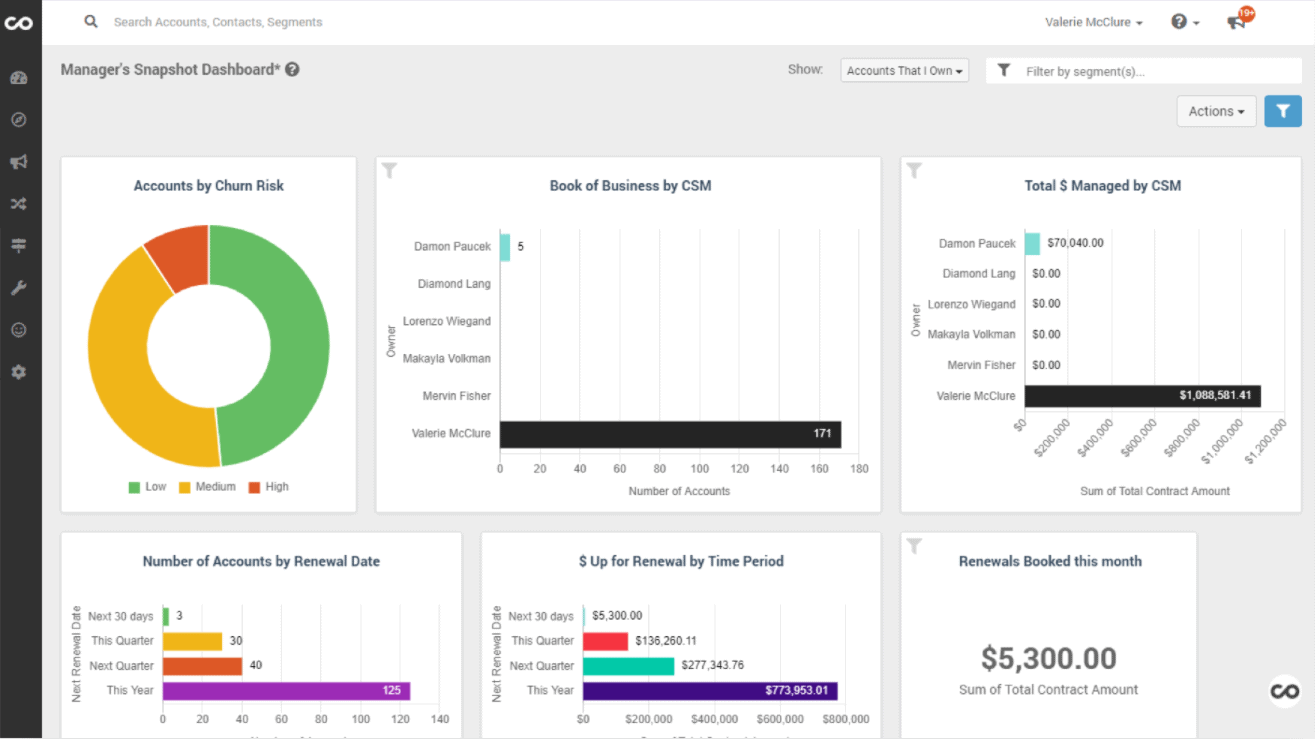
Why ChurnZero: ChurnZero is a customer success platform purpose-built to help subscription businesses (especially B2B SaaS) manage customer health and minimize churn. It offers a rich set of features centered on churn risk identification and customer engagement.
ChurnZero consolidates customer data from various sources (product usage metrics, CRM data, support interactions, billing records) to create a holistic view of each account. From this data, it generates customer health scores that predict the likelihood of churn or renewal. These scores are presented on a dashboard, so CSMs can instantly see which accounts are green (healthy) vs yellow or red (at risk).
One strength is real-time visibility. As customers use your product, ChurnZero can track key events (login frequency, feature adoption, etc.) and update health scores or trigger alerts when things change. Beyond monitoring, it provides tools for CSMs to take proactive action. You can set up automated playbooks (if an account’s usage drops by 50% month-over-month, ChurnZero can automatically schedule an email sequence or create a task for the account owner).
Integrations: ChurnZero is designed to fit into the SaaS business tech stack. It integrates with popular CRMs (Salesforce, HubSpot, NetSuite, Zoho CRM), financial systems (Chargebee, Stripe for subscription data), and support tools like Zendesk. It also has its own APIs and can import data via CSV. The Salesforce integration is especially deep, allowing bi-directional sync of customer info and health metrics.
Pricing: ChurnZero doesn’t publicly list pricing. It’s typically offered as an annual SaaS subscription based on the size of your customer base or features needed. You’ll have to contact ChurnZero for a custom quote. They tend to price competitively relative to big players like Gainsight. There is no free plan, but you can request a demo.
What it’s great at:
- Comprehensive health scoring: Customizable health scoring that takes into account multiple dimensions (usage, support tickets, survey responses, etc.).
- Automation for CS teams: Enables automation of customer success workflows, reducing manual work.
- Customer engagement tools: Built-in options to engage customers, such as in-app messages, pop-ups, and triggered emails.
- Deep analytics and segmentation: Robust reporting on churn-related metrics with customer segmentation by behavior.
- Integrating churn into CRM: For companies that live in CRM, ChurnZero can feed churn insights right into those systems.
Areas of limitation:
- Requires data alignment. To get the most from ChurnZero, your various data sources need to be connected and accurate.
- Learning curve for full features. ChurnZero is packed with features, which can be a lot for a small CS team initially.
- No public pricing.
- Primarily for CSM-led businesses. If you have a low-touch or tech-touch customer model, some strengths may be less relevant.
- Limited free trial options.
#7 Best For Support-driven churn management – Zendesk
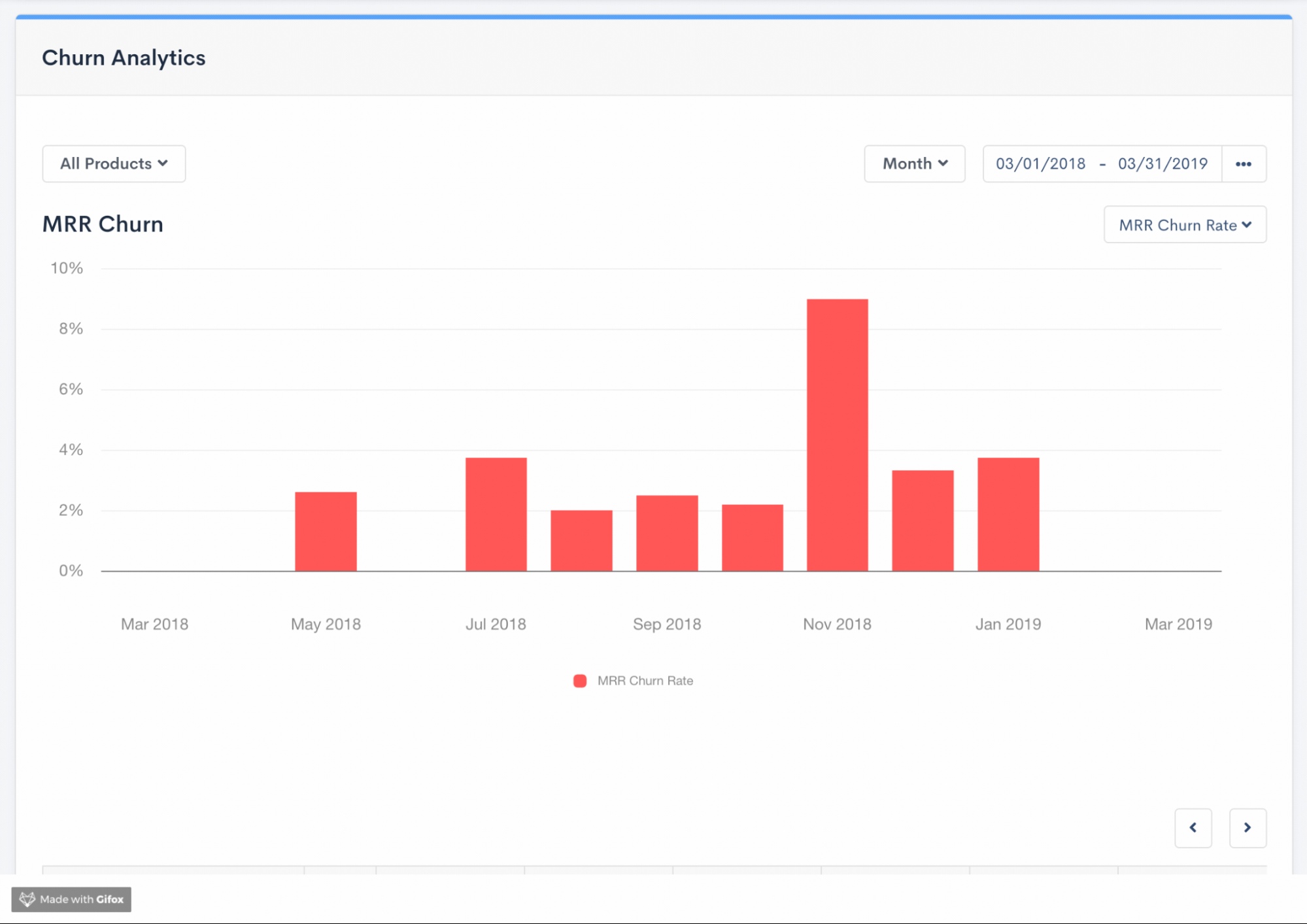
Why Zendesk: Zendesk is widely known as a customer service and support platform, and it has recently enhanced its offerings to help companies tackle churn through better customer experience management. While not a dedicated churn prediction tool, its AI-powered customer service suite can effectively predict and prevent churn by analyzing support interactions and customer sentiments.
Zendesk’s tools unify all the ways customers reach out (email, chat, social, phone, etc.) into one hub. This 360° view allows companies to track issues and respond faster, which directly improves satisfaction and retention.
Notably, Zendesk introduced features like AI-powered quality assurance (QA) and sentiment analysis that monitor 100% of support tickets and conversations to gauge customer happiness. The AI (including a feature they call Spotlight) flags potentially “problematic” cases. If it detects angry sentiment or repeated complaints, it highlights those customers as needing urgent attention. This effectively acts as a churn prediction signal, since unresolved support issues or negative sentiment often lead to churn.
Integrations: Zendesk has a vast marketplace of integrations and apps. It can integrate with CRMs (like Salesforce or HubSpot), e-commerce platforms, social media, and many third-party tools. It also provides an open API. For churn-specific use cases, Zendesk integrates with customer success platforms (Zendesk data can flow into tools like Gainsight or ChurnZero, and vice versa).
Pricing: Zendesk’s pricing is tiered based on functionality and typically charged per support agent. Plans for the core Suite start at $25 per agent/month for basic teams, ranging up to $99+ per agent/month for the Enterprise tier with advanced AI features. Zendesk often provides a 14-day free trial. Keep in mind costs can grow with your support team size.
What it’s great at:
- Customer service excellence: Improves the support experience, which is directly tied to churn.
- AI-driven churn signals: Through sentiment analysis and QA, automatically surfaces at-risk customers hidden in your support queue.
- Unified omnichannel view: All customer interactions in one place.
- Self-service and community: Help center and community forum features empower customers to resolve issues quickly.
- Scalability and reliability: Proven platform that scales from small startups to huge enterprises.
Areas of limitation:
- Not solely a churn tool. Zendesk is first and foremost a support platform. To directly predict churn, you either use its signals or integrate it with dedicated churn analytics.
- Limited predictive analytics outside of support context.
- Cost scales with agents.
- Complexity at enterprise tier.
- Churn analysis is indirect. Zendesk has very limited churn-specific analysis since it’s primarily a CRM/helpdesk system.
#8 Best For Easy AI modeling for churn (no-code ML) – Akkio
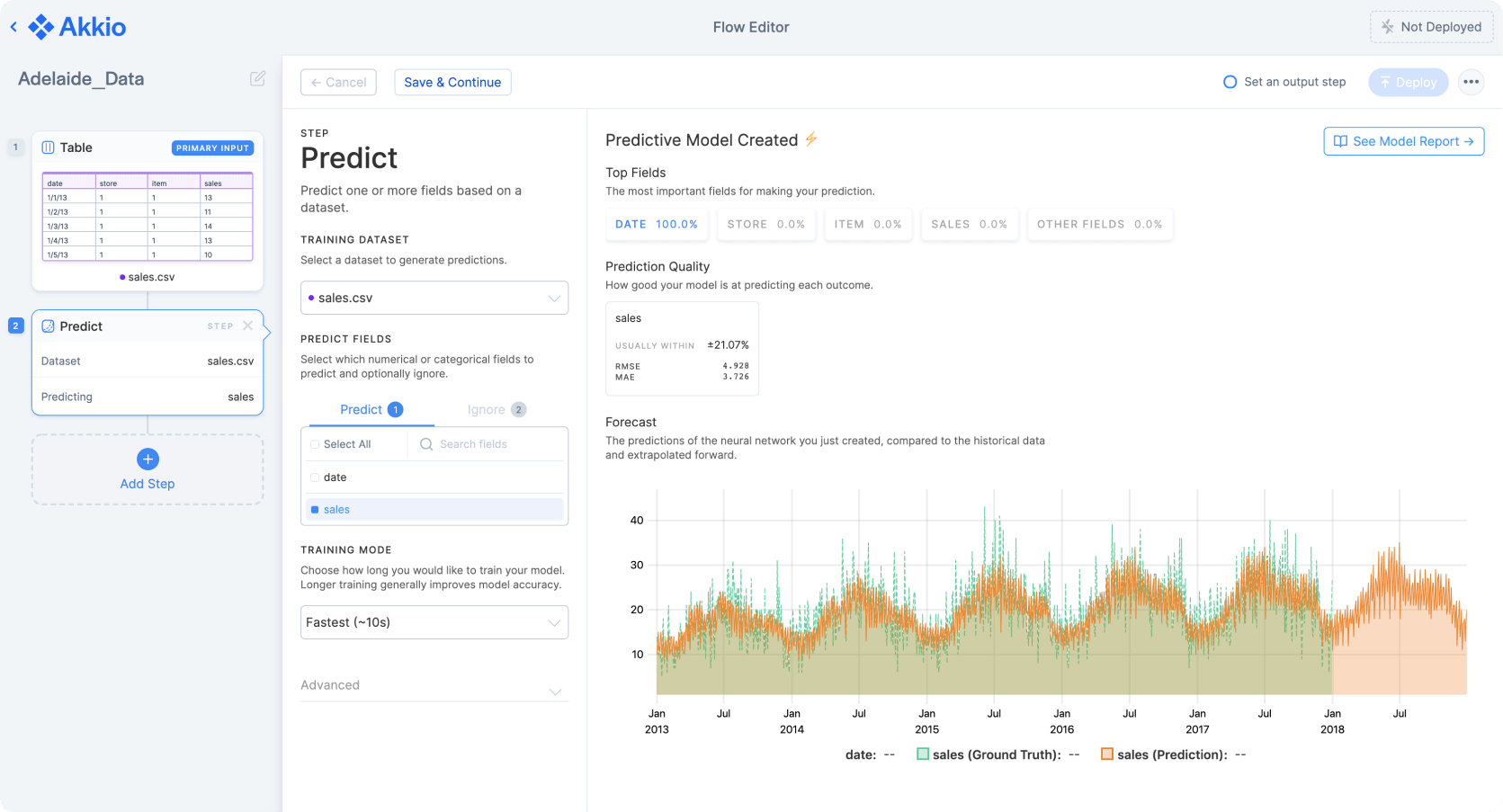
Why Akkio: Akkio is a newer entrant that provides a user-friendly AI platform for business predictions, including churn. Think of Akkio as a lightweight, no-code machine learning tool that anyone on your team can use to build a model from data. For churn prediction, you can feed Akkio your historical customer dataset (with columns for customer attributes and whether they churned), and it will automatically train a model to identify patterns.
Akkio’s emphasis is on simplicity and speed. It automates the ML pipeline, from data cleaning to model selection, and outputs churn risk scores for each customer. You can literally drag and drop a spreadsheet or connect a data source, and Akkio’s AI will suggest the best predictive model. It also provides insights like which factors are most important in predicting churn.
Integrations: Akkio offers integrations with common data sources. It can connect to databases, spreadsheets (Google Sheets), business apps via Zapier, and BI tools. You could link Akkio to your HubSpot or Stripe data through Zapier, build a churn model, and deploy the predictions back into a CRM or dashboard. It also has an API for developers to integrate predictions into your product or workflows.
Pricing: Akkio’s pricing is relatively transparent. They have a free tier for basic usage and testing. Paid plans start at around $50 per month for the Starter (with limits on data rows and prediction volume). The Pro plan is around $250/mo, allowing for more data and concurrent predictions, with Business plans above that for teams and higher volumes. A free trial is available.
What it’s great at:
- Ease of use: Built for the non-technical user. If you can use Excel, you can likely use Akkio.
- Fast deployment: Go from raw data to a live prediction model in minutes to hours.
- Automated ML features: Handles algorithm selection and tuning automatically.
- Cost-effective: For small and medium businesses, Akkio’s price point is very accessible.
- Multi-purpose AI tool: Use it beyond churn for forecasting sales, identifying upsell opportunities, or any classification/regression task.
Areas of limitation:
- Not specialized in churn. It won’t come with churn-specific dashboards or playbooks.
- Limited deep customization. Less control over the model’s innards.
- Data preparation is still on you.
- Scaling to very large data (millions of customers) might hit limits.
- Support and community are growing but not as extensive as established enterprise software.
#9 Best For Product-led startups & CS team collaboration – Vitally
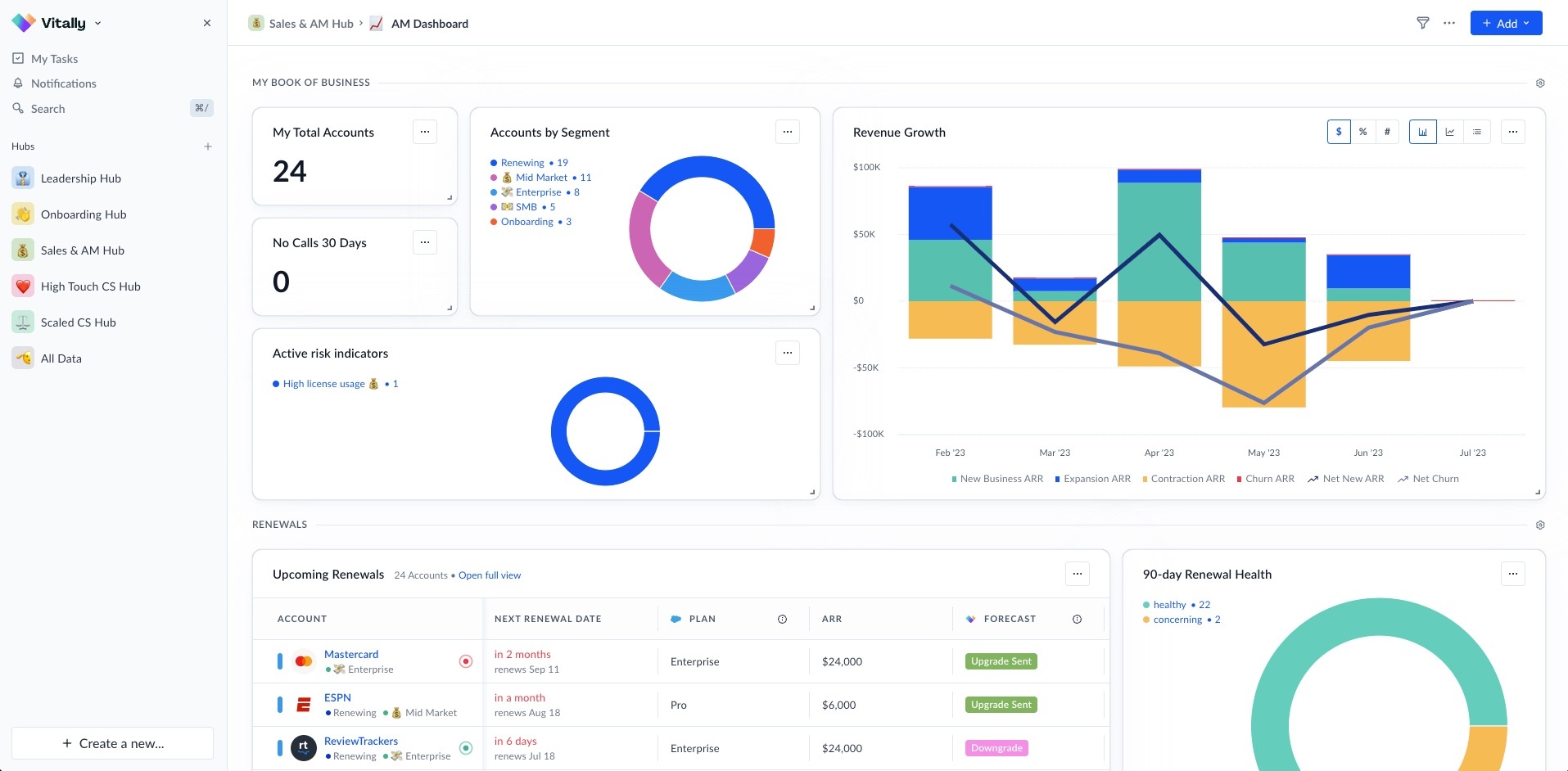
Why Vitally: Vitally is a customer success platform tailored for modern SaaS teams, especially those operating with a product-led growth approach. It combines customer success management with a strong analytics backbone. Vitally’s goal is to create a collaborative workspace for CS teams while providing real-time visibility into customer health.
It tracks customer interactions across various platforms (your app/product, emails, support) and aggregates them into one view. Using this data, Vitally computes health scores and alerts to signal which accounts might be at risk of churn.
What sets Vitally apart is its focus on automation and productivity for CS teams. It offers project management-like features (tasks, notes, playbooks) alongside churn analytics. As soon as an account is flagged as at-risk, Vitally can automatically create an action item for the CSM or trigger a pre-defined workflow.
Integrations: Vitally integrates with many common SaaS tools. It connects with CRMs (Salesforce, HubSpot), support systems (Intercom, Zendesk), product analytics (Mixpanel, Segment), billing systems (Stripe, Chargebee), and more. It also has an API and webhooks for custom integrations. Vitally can sit on top of a modern data stack too, pulling data from a warehouse like Snowflake.
Pricing: Vitally doesn’t publish straightforward pricing. It’s usually a subscription based on your number of users (CSM seats) and potentially the size of your customer base or revenue. You’ll have to contact Vitally for pricing. They position themselves as a cost-effective alternative to bigger players. There’s no free tier, but Vitally has been known to offer a trial or proof-of-concept period.
What it’s great at:
- Real-time health monitoring: Updates customer health scores continuously as new data flows in.
- Collaboration and productivity: Built for CS teamwork. Assign tasks, leave notes, and track projects within the same app as the health data.
- Customizable analytics: Tailor what factors go into your health scores and alerts.
- Customer communications: Manage customer touchpoints, from scheduling QBRs to sending automated check-in emails.
- Built for product-led and SaaS models: Can track individual user behaviors, not just account-level.
Areas of limitation:
- Relatively new entrant. Might not have the same depth of features as older platforms.
- Focus on mid-market. Very large enterprises might find Vitally less comprehensive than something like Gainsight.
- No built-in AI modeling (yet). Scores are rules-based or simple weighted models.
- Limited “project management” scope compared to dedicated PM tools.
- Onboarding needed to set up health formulas and integrate data.
#10 Best For Subscription businesses focusing on NPS/CSAT – Retently
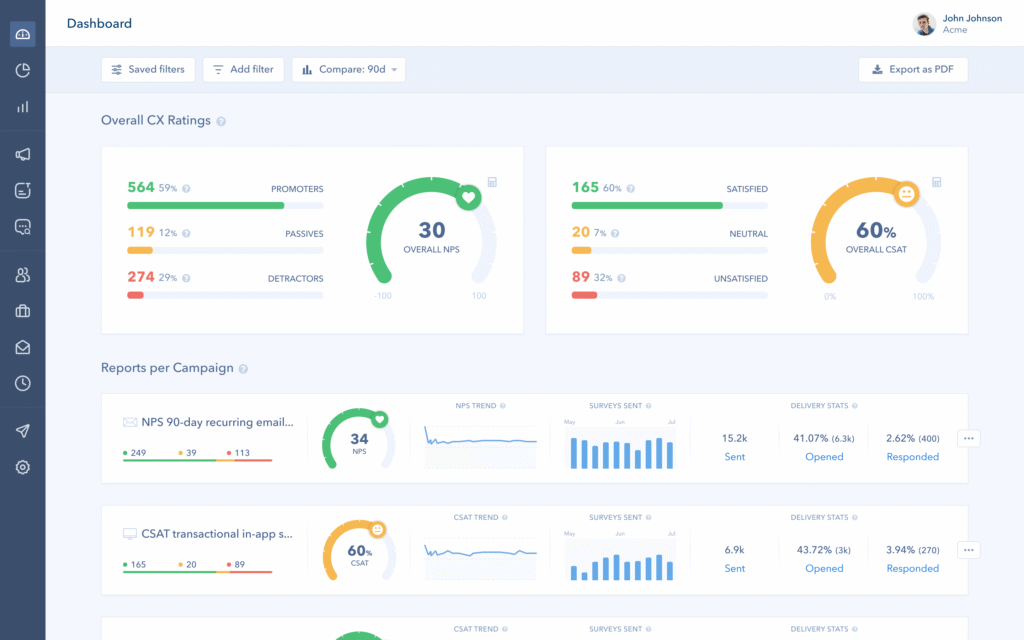
Why Retently: Retently is a customer retention platform with a strong focus on customer feedback and satisfaction metrics to predict churn. It’s particularly well-suited for subscription-based businesses that use metrics like NPS (Net Promoter Score), CSAT, or CES to gauge customer sentiment.
The idea behind Retently is that by regularly collecting feedback and sentiment data from your customers, you can foresee who is unhappy and likely to churn, then take steps to improve their experience. Retently uses machine learning to analyze feedback data alongside usage trends to produce customer health scores indicating churn risk. If a customer’s NPS drops or they give a poor satisfaction rating, Retently’s model weighs that heavily in their risk score.
Retently doesn’t just stop at insight. It provides tools to improve customer sentiment. You can set up automated email campaigns for different segments, such as win-back campaigns for low-engagement users or educational content for those who gave neutral feedback. Retently tracks how these interventions impact your scores over time.
Integrations: Retently integrates with a variety of services common in SaaS and ecommerce, including CRMs, email marketing platforms, help desks, and data sources. It can tie into Intercom, HubSpot, Salesforce, or Zendesk to pull customer info and send surveys. It also integrates with Slack (so your team can get alerted when a detractor response comes in) and has API/webhooks for custom connections.
Pricing: Retently’s pricing is tiered based on the number of survey responses and features. Plans often start around $59 per month for small-scale usage and scale up with volume. Free trials of 7 to 14 days are available. Overall, Retently is moderately priced, aimed at SMBs and mid-market companies.
What it’s great at:
- Customer feedback-driven: Excels at systematically capturing the voice of the customer through NPS and making sense of it.
- NPS expertise: Provides a framework and best practices for running a good NPS program.
- Churn scoring from sentiment: Combines sentiment metrics with usage trends for holistic health scores.
- Actionable playbooks: Set up follow-up actions. For example, automatically email any detractor within 24 hours.
- Focused and user-friendly: Does one thing and does it well. The interface is straightforward and reporting is clear.
Areas of limitation:
- Limited view if not collecting feedback. Accuracy depends on getting customers to respond to surveys.
- Not a full CS platform. Doesn’t manage tasks, QBRs, or detailed account plans.
- Potential survey fatigue if not designed thoughtfully.
- Data from other sources might not be as comprehensive.
- Scaling to enterprise (large organizations with millions of users) might find Retently’s focus a bit narrow.
The bottom line: Choose the right tool and start predicting
If you want to retain as many customers as possible, two capabilities are key: predicting churn and understanding which strategies will prevent disengagement. The tools we’ve discussed each approach this in a unique way (from AI-driven analytics to customer feedback loops), but all share the same goal of keeping your customers on board.
Investing in churn prediction software can pay massive dividends. By identifying which customers are at risk before they actually churn, you give yourself the chance to intervene with personalized retention tactics. That might mean offering a discount, providing extra support, re-onboarding them to underused features, or simply reaching out to rebuild the relationship. These proactive saves not only preserve revenue but also foster goodwill and loyalty.
Importantly, churn prediction solutions don’t just flag risks. Many also shed light on why customers might be leaving. Are they unhappy with service quality? Is a particular product feature causing frustration? Are they outgrowing your offering? Knowing the drivers of churn helps you fix underlying issues, improve your product, and refine your customer success approach for the future.
Among these options, Pecan AI stands out for its powerful combination of automated data analysis and predictive modeling tailored to business outcomes. Pecan’s platform offers robust AI and modeling capabilities to analyze churn patterns and deliver accurate predictions, all in a user-friendly package. In 2026, Pecan’s introduction of a generative AI co-pilot further democratized predictive analytics, enabling even non-technical teams to harness the power of machine learning for churn reduction. With Pecan, organizations can quickly turn raw customer data into actionable churn insights in a way that aligns with their current tools and workflows.
The ideal churn prediction software selection hinges on your company’s scale, available resources, and unique requirements. However, utilizing such tools, individually or in concert, is increasingly essential in today’s customer-focused business landscape. Businesses that actively anticipate and mitigate churn will likely experience superior retention, cultivate more devoted customers, and achieve more robust growth compared to those that respond only after the fact.
Ready to start predicting churn before it happens and keep your best customers happy? Modern churn prediction solutions like Pecan can make it fast and feasible. If you’re interested in seeing how Pecan’s customized predictive models could work for your business, you can request a guided demo to get a hands-on tour. Don’t let churn chip away at your hard-earned revenue. Equip your team with the insights to act with confidence and turn potential losses into long-term wins.

Team Pecan is what happens when you put a bunch of data geeks in a room and tell them to make machine learning suck less. We’ve built models, broken models, fixed models, and occasionally questioned our life choices at 2am debugging feature pipelines. Now we write about it so you don’t have to learn the hard way. Think of us as your slightly unhinged data science friends who actually want you to succeed.